

The National Popular Vote Interstate Compact: A Backdoor Attempt to Rewrite the Constitution Without Amending It
Why Congress Should Act Before It Is Too Late
For decades, efforts to abolish the Electoral College have failed because the Constitution requires a constitutional amendment to fundamentally change the method of electing the president. Rather than pursue Article V, supporters have adopted a different strategy: the National Popular Vote Interstate Compact (NPVIC).
The compact requires participating states to award all of their electoral votes to the winner of the national popular vote, regardless of how their own citizens voted. Once states totaling 270 electoral votes join, the compact takes effect automatically, effectively replacing the Electoral College with a national popular vote without changing a single word of the Constitution. Today, the compact stands at 222 electoral votes, just 48 votes away from becoming operative. The most recent state to join was Virginia in April 2026, with Governor Abigail Spanberger signing the legislation.
Why the NPVIC Is Unconstitutional
1. It circumvents Article V.
The Constitution provides one method for fundamentally changing the presidential election system: constitutional amendment. The NPVIC attempts to accomplish through coordinated state legislation what Article V reserves to the amendment process. It preserves the shell of the Electoral College while replacing its substance.
2. It exceeds the states’ Article II authority.
Article II allows each state legislature to determine how its own electors are appointed. It does not expressly authorize a coalition of states to convert the Constitution’s state-based presidential election system into a de facto national popular election. No Supreme Court decision has upheld such a use of Article II.
3. It implicates the Compact Clause.
Interstate compacts are common and often beneficial. States routinely cooperate on transportation, water rights, emergency management, and law enforcement. But the Constitution requires congressional consent for interstate agreements that increase the collective political power of states in relation to the national government. The NPVIC is unlike ordinary interstate compacts because it coordinates state authority to determine the election of the President of the United States, and the compact cannot come into effect without Congressional consent.
4. It nationalizes elections without national election laws.
Under the compact, participating states would award electors based on ballots cast and counted under dozens of different state laws governing voter ID, absentee ballots, recounts, certification, and among other things. Electoral outcomes for president in a state would therefore be dependent on the electoral outcomes in other states and other states’ electoral laws and not just that one state’s. Our Constitution has never before operated in such a patchwork of dubious legal standards.
Congress Can Act Now
Congress does not have to wait until the compact reaches 270 electoral votes.
The NPVIC would be the type of interstate compact requiring congressional consent, and Congress can act now by expressly denying consent to the compact through ordinary legislation. Such legislation would reaffirm that the Electoral College cannot be fundamentally altered through coordinated interstate agreements and that any change to the Constitution’s presidential election system must occur through Article V, not by compact. The president’s signature would reaffirm the Constitution’s existing framework and preserve Congress’s role in protecting the constitutional structure.
For the full constitutional and historical analysis, see The Center for Renewing America’s legal primer, The Interstate Compact Complication: The Left’s Backdoor Attempt to Abolish the Electoral College, by Benjamin Osborne.

Related Posts
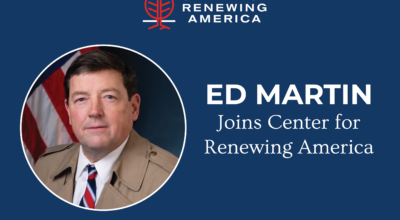
Former Trump DOJ Official Ed Martin Joins Center for Renewing America As Distinguished Fellow
Today the Center for Renewing America (CRA), founded by White House Office of Management and Budget Director Russ Vought, announced that Edward R. Martin Jr., a veteran public servant and former senior official in the Trump Administration’s Department of Justice, will join the organization as a Distinguished Fellow.

Primer: Introducing the Campus Safety Tracker
The launch of the Campus Safety Tracker is designed to give citizens insight into the policies and political dynamics in the counties where these universities are located. Knowing the relative vulnerability of students to violent crime and illegal immigrant–driven chaos is an underappreciated but important data point when assessing whether a particular school is a good fit.

Introduction to the Red-Green Alliance Against Western Civilization
The term Red-Green Alliance refers to the growing left-wing political coalition of neo-Marxist progressives and anti-Western Islamists. Despite the inherent contradictions between these two ideologies (with progressives championing feminism and LGBTQ+ causes while Islam forbids homosexuality and restricts women), a de facto coalition has emerged. Both groups are united in their commitment to tear down the traditional American way of life.