
Primer: Introducing the Campus Safety Tracker
The launch of the Campus Safety Tracker is designed to give citizens insight into the policies and political dynamics in the counties where these universities are located. Knowing the relative vulnerability of students to violent crime and illegal immigrant–driven chaos is an underappreciated but important data point when assessing whether a particular school is a good fit.
Synopsis
The value of higher education in America has never been more questionable. Student loan debt currently exceeds $1.83 trillion, and many graduates who are fortunate enough to enter the workplace with a dubious degree are ill-equipped to contribute.1 A recent report suggested that a substantial number of college students cannot do basic math,2 and the number of graduates struggling to find employment is rising.3 This is largely because universities are no longer in the business of education and civic preparation but have been wholly captured by progressive ideology.
The doubtful value of many college degrees and the intentional radicalization of students on many campuses are among the major factors leading Americans to question the benefits of higher education. And recent high-profile murders of college students raise a more fundamental concern about America’s college campuses: How vulnerable are students at major universities to crime and the destructive societal impacts of illegal immigration?
In answer to that question, the Center for Renewing America has developed a first-of-its-kind Campus Safety Tracker to determine the relative safety of college students at major universities.
Background
Perhaps no moment has crystallized the frightening reality of radicalization on college campuses more clearly than the assassination of Charlie Kirk at Utah Valley University on September 10, 2025, by a murderous trans-supporting leftist. Of course, the increasingly radical environment of America’s universities predates that horrific event. For the last two years, pro-jihadist, anti-American mobs on college campuses have terrorized other students in full support of Hamas and other barbaric Islamist movements.4
Yet, even those spine-chilling realities fail to fully capture the state of American universities. In 2024, the murder of Laken Riley by an illegal alien at the University of Georgia grabbed the nation’s attention and supercharged attention on sanctuary policies and soft-on-crime prosecutors.5 Earlier this year, the murder of Sheridan Gorman by a Venezuelan illegal immigrant at Loyola University in Chicago served as a painful reminder of the failures of the Biden administration,6 whose catch-and-release policies allowed the murderer to enter America illegally and remain in the country without consequence.7
As parents evaluate whether college is “worth it,” public policies that affect students’ safety, whether positively or negatively, should remain at the forefront of their decisions. However, many parents simply don’t know whether a college or university possesses an environment that would make their son or daughter more vulnerable to crime and the unique societal disruption that stems from illegal immigration. The Campus Safety Tracker aims to address this concern by providing a score for each major college indicating a student’s relative vulnerability to these threats.
Analysis: The Center for Renewing America’s Campus Safety Tracker
The initial launch of the Campus Safety Tracker includes 161 major colleges and universities. This tool will be updated annually and will eventually include most schools, including smaller institutions. The tracker’s criteria are divided into six major categories, yielding an aggregate score from 1 to 20. The higher a university’s score, the more vulnerable students are to crime and illegal immigrant–driven chaos relative to other universities. These categories include the following:
- Sanctuary Status: The university is evaluated based on whether it is located in a sanctuary state, sanctuary county, or sanctuary city. The sanctuary status is pulled directly from the Federation for American Immigration Reform database, published in June 2025.8 For sanctuary state status, the tracker relies on the current list of sanctuary states as evaluated by the Department of Justice.9 Sanctuary status encompasses a relatively broad range of policies, including measures as extreme as a total refusal to follow federal immigration law, prohibitions on detainer compliance, opposition to participation in the 287(g) program, and prevention of status inquiries. The tracker does not simply take a jurisdiction’s word for it regarding sanctuary status.
Score Impact: If a university is in a sanctuary jurisdiction, the school’s Vulnerability score increases by 4 points.
- 287(g) Participation: The university is evaluated based on whether it is located in a jurisdiction that participates in the 287(g) program under the Immigration and Nationality Act. This program allows members of local law enforcement to help uphold federal immigration law through participation in training that, among other provisions, fully deputizes them to detain illegal immigrants with orders for removal. In the context of the tracker, participation or nonparticipation reflects the local sheriff’s policies and prerogatives.
Score Impact: If the county where the university is located is not participating in the 287(g) program, the school’s Vulnerability score increases by 3 points.
- Crime Rates: The university is evaluated based on the county’s crime rate relative to the national average. The crime rate is broken out into three different levels: Low, Medium, and High. The data for the evaluation of the crime rate are largely drawn from the latest FBI Crime Data Explorer statistics, but also incorporate other publicly available reports and databases on local crime rates.
Score Impact: If the county where the university is located has Low crime, the school’s Vulnerability score increases by 1 point. If the university is located in an area with Medium crime that mostly tracks the national average, its Vulnerability score increases by 3 points. If the university is in an area with High crime that is above the national average, the Vulnerability score increases by 5 points. A high crime rate is the single biggest contributing factor to the Campus Safety Tracker.
- Student-to-Population Ratio: The university is evaluated based on its student population relative to the county’s total population. The county population data are taken directly from the latest census data, and the school population data are taken from the most recently published campus enrollment figures. For some schools, the data are from 2024; for others, they are from fall 2025. The larger the ratio, the more vulnerable students are to crime and illegal-immigrant chaos because students constitute a larger number of possible victims in the area. The smaller the ratio, the less vulnerable the students are.
Score Impact: If the student population ratio is 5 percent or under, the school’s Vulnerability score is not impacted. If the ratio reaches 10 percent, the school’s Vulnerability score increases by 1 point. If the ratio is between 10 percent and 20 percent, the school’s score increases by 2 points. If the school’s score is between 20 percent and 33 percent, it increases by 3 points. Any ratio above 33 percent results in a 4-point increase in the score.
- Political Climate: The university is evaluated based on the county’s political climate. “Political climate” refers to the population’s overall attitude toward law enforcement, be it “defund the police” efforts, support or opposition for sanctuary policies, or support or opposition for soft-on-crime elected officials. This attitude is categorized as either Pro-Enforcement or Anti-Enforcement based on recent political trends in the county.
Score Impact: If the political climate in the county where the university is located is Anti-Enforcement, the school’s Vulnerability score increases by 1 point. If the climate is Pro-Enforcement, the school’s Vulnerability score is not impacted.
- Progressive District Attorney: The university is evaluated based on the county’s district attorney (DA), specifically, whether the county has a “progressive” DA who proactively decriminalizes criminal activity, eliminates cash bail, aggressively targets law enforcement, implements soft-on-crime drug approaches, or infuses law enforcement with woke and weaponized DEI policies that diminish victims in favor of criminals’ “rights.” If students are attending a university that is under the purview of a progressive DA, then they are considered more vulnerable to the predation of criminals and violent illegal aliens.
Score Impact: If the county where a university is located has a progressive prosecutor, the school’s Vulnerability score increases by 3 points. Importantly, progressive prosecutors are not strictly limited to George Soros–funded DAs; they are instead evaluated based on the totality of a DA’s policy approaches. The tracker assesses whether a prosecutor supports or implements any of the policies mentioned above that elevate criminals over justice for victims. This means the tracker rejects the narrow corporate media-driven definition of what constitutes a progressive prosecutor.
Final Assessment
When these six criteria are aggregated, each school is assigned a total Vulnerability score. These scores are not frozen in amber but can fluctuate year to year due to changes in public policy, political leadership, and potential demographic shifts. Critically, the scores are not absolute markers but rather relative indicators compared with other universities. There is no guarantee that a student at a school with Low vulnerability will never experience violent crime, just as there is no guarantee that a student at a school with Very High vulnerability will frequently experience violent crime.
Instead, the tracker should be understood as measuring risk relative to other institutions rather than absolute risk at all times. For evaluation purposes, each school is categorized in the following manner:
- Low Vulnerability: A university with a score of 5 or lower is considered safer than other universities on the tracker. Currently, there are 29 schools in the Low category (18 percent of all schools evaluated).
- Medium Vulnerability: A university with a score of 6–10 is considered to be in an area with elevated risks, likely stemming from existing policy choices or crime rates. These schools are generally in areas consistent with the national average. Currently, there are 46 schools in the Medium category (28.6 percent of all schools evaluated).
- High Vulnerability: A university with a score of 11–15 is considered high risk compared to other universities, stemming from a combination of poor policies and poor political decision-making. Currently, there are 58 schools in the High category (36 percent of all schools evaluated).
- Very High Vulnerability: A university with a score of 16 or higher is considered to be among the most unsafe environments relative to other universities, stemming from willfully poor policy decisions and intentionally destructive political decision-making. Currently, there are 28 schools in the Very High category (17.4 percent of all schools evaluated).
Key Findings
View the full 2026 Campus Safety Tracker here.
The initial findings of the Campus Safety Tracker are multifaceted and instructive for students and parents alike. Most schools receive a rating of either Medium or High Vulnerability due to the policies and political dynamics in the counties where major universities are located. Below, we look at several examples.
University of Georgia
The murder of Laken Riley shook the nation because of both its gruesome nature and the political implications of its preventability and senselessness. While out for a jog the morning of February 22, 2024, Riley was brutally murdered by a Venezuelan illegal alien near the campus of the University of Georgia. When evaluating the policies and political climate in Clarke County, it is clear that students were and remain in a vulnerable environment.
The University of Georgia is considered the most vulnerable campus in the Southeastern Conference, with a High Vulnerability score of 15. At the time that Riley was murdered, the school’s score would have been an astounding 18 (nearly maxing out the tracker). However, voters took matters into their own hands in November 2024 and have since replaced the ultraprogressive DA with one who is more committed to law enforcement, thereby lowering the Vulnerability score from Very High to High.
Loyola University
The more recent murder of Sheridan Gorman at Loyola University in Chicago tragically mirrors many of the facts of Riley’s death. Gorman was killed by a Venezuelan illegal immigrant on March 19, 2026, while on a pier with friends near campus, taking pictures of the city skyline. For purposes of the tracker, Loyola was included not because it is considered a major university but because of Gorman’s murder. The result is unsurprising but instructive. Loyola has a Very High Vulnerability score of 16, making it a school where its students are most susceptible to violent crime and the effects of illegal immigrant–driven chaos.
Chicago is a sanctuary city that does not allow its local police to operate under the 287(g) program. Cook County has a high crime rate, a radical progressive prosecutor, and a political climate that vehemently opposes strong law enforcement measures. For students at Loyola, the greatest protection comes not from city policies or competent political leadership but from the school’s small student population. For purposes of the tracker, the only benefit Loyola confers is that there are fewer students overall at risk of becoming crime victims than at other universities nationwide.
Auburn University
An unusual example of unnecessarily elevated student vulnerability is Lee County, Alabama, a deeply conservative county home to roughly 35,000 students at Auburn University. The university has a Medium Vulnerability score of 8 on the tracker. Auburn’s student body is considered among the most conservative in the nation.10 The county, however, also contains a growing number of illegal immigrants, including violent criminals. On April 15, 2026, a sheriff’s deputy was shot in the line of duty after attempting to serve an arrest warrant against a Guatemalan national for first-degree rape.11
The sheriff’s race this past spring focused on the 287(g) program as the longtime Republican incumbent, Jay Jones, refused to participate in the program, arguing that it entailed administrative and liability costs.12 It is important to note that the Department of Homeland Security offers reimbursements for at least some of the administrative costs, which would be minimal.13 Further, much smaller law enforcement agencies in nearby towns participate with little concern about the alleged costs, calling into question the sheriff’s excuses for not participating in the 287(g) program. Voters seemingly agreed, unceremoniously dumping the 30-year incumbent in favor of a challenger, Cam Hunt, who promised to implement the 287(g) program if elected.
These dynamics explain why Auburn University, despite being in a deep-red county in a deep-red state with a current Republican sheriff, has an unusually high Vulnerability score for its students—one that could be easily lowered if the newly elected sheriff participates in the 287(g) program.
The lesson from Auburn University can be extrapolated to other universities in the tracker. If local sheriffs simply used the readily available 287(g) program, enforcement against criminal activity by illegal aliens would increase and likely reduce overall crime rates in the community, thereby providing much greater protection for college students in the area. Implementing the 287(g) program is one of the quickest ways to improve a school’s Vulnerability score.
Brigham Young University
One of the 29 schools evaluated with a Low Vulnerability score is Brigham Young University (BYU) in Utah, which is tied with two other schools (the University of North Texas and Miami University in Ohio) for the lowest overall Vulnerability score among the major universities included in the tracker. Coming in with an impressive score of 1, BYU offers its students a low crime rate, a very low student-to-population ratio, and strong enforcement policies across the board in Utah County. While this score does not guarantee immunity from violent crime, it suggests that relative to students at other major schools, BYU’s students are among the least susceptible to such events.
University of Arizona
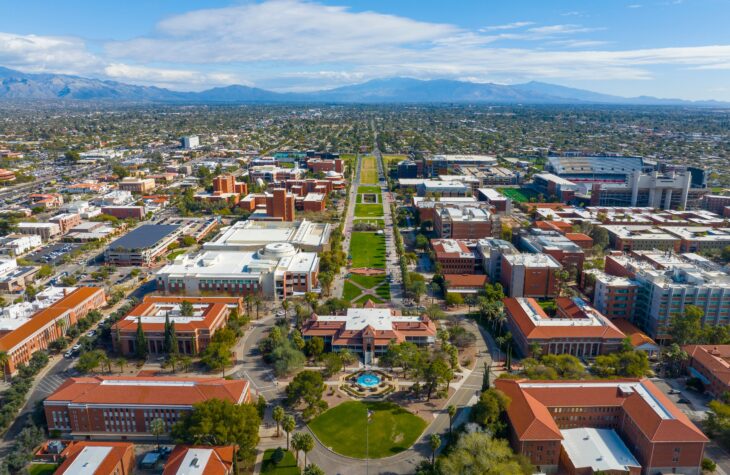
Located in the heart of Pima County, Arizona, the University of Arizona has the dubious honor of being tied for last on the inaugural Campus Safety Tracker, alongside Duke University, the University of Oregon, and the University of Texas at El Paso. With an eye-popping Very High Vulnerability score of 17, the University of Arizona “protects” its students solely by offering a smaller student-to-population ratio in a county with more than one million people. Nearly every policy in Pima County undermines law enforcement, from its sanctuary status to its refusal to operate under the 287(g) program and the presence of a committed progressive prosecutor. Pima County has a high crime rate and a political climate that increasingly opposes law enforcement.
Among major universities, the University of Arizona is tied for the most vulnerable in the nation to violent crime and the broader societal chaos caused by illegal immigrants.
In the fall of 2024, a University of Arizona student was arrested on federal felony charges for assisting cartels in drug smuggling and human trafficking operations.14 Just a few weeks later, a man was arrested—and later convicted and sentenced—for murdering a Pima Community College student on the University of Arizona’s campus during an argument on a volleyball court.15 In February 2026, a University of Arizona student was violently assaulted; she defended herself from two attackers with a kitchen knife after the men broke into her apartment.16 The school’s tracker score suggests that such incidents are more likely to occur at the University of Arizona than at other universities.
Duke University
Located in Durham County, North Carolina, Duke shares the same dubious honor as the University of Arizona. The school’s Very High Vulnerability rating of 17 stems from a higher-than-average crime rate, local sanctuary policies, anti-enforcement political sentiments shared by the electorate, and a progressive district attorney. Like students at the University of Arizona, Duke students are “protected” only by virtue of a small student-to-population ratio in a county of nearly 350,000 people. Duke’s students are more vulnerable to violent crime and the predation of illegal immigrant–driven chaos than students at other major schools.
In the fall of 2024, a Duke student was attacked in the Brightleaf area of Durham in an aggravated assault, resulting in the student’s hospitalization.17 In 2022, five Duke students were held hostage in their apartment at gunpoint during an armed robbery.18 As with the University of Arizona, Duke’s score on the tracker suggests that such incidents are more likely to occur there than at other universities.
Conclusion
As Americans increasingly question the value of the country’s higher education system, it is important to evaluate more fundamental criteria for whether college is “worth it.” Chief among those criteria are students’ susceptibility to violent crime and the societal chaos inflicted on residents by illegal immigration—cartel activities, drug proliferation, and human trafficking. The high-profile murders of Laken Riley and Sheridan Gorman by criminal illegal aliens were both preventable and senseless. However, when evaluating universities with the Campus Safety Tracker, both incidents occurred at schools rated as Very High Vulnerability due to wrongheaded public policies and anti-enforcement political climates.
The launch of the Campus Safety Tracker is designed to give citizens insight into the policies and political dynamics in the counties where these universities are located. Further, the tracker provides additional value to prospective students, current students, parents, alumni, and faculty regarding America’s major colleges. Knowing the relative vulnerability of students to violent crime and illegal immigrant–driven chaos is an underappreciated but important data point when assessing whether a particular school is a good fit.
While much has rightfully been made of the progressive ideological violence that pervades college campuses, the tracker ultimately aims to evaluate the increasingly fragile state of public safety in areas home to millions of American students.
Endnotes
1. Schulz, M. and Shepard, D. (February 25, 2026). “Student Loan Debt Statistics,” LendingTree. https://www.lendingtree.com/student/student-loan-debt-statistics/
2. Finley, A. (November 30, 2025). “The College Students Who Can’t Do Elementary Math,” The Wall Street Journal. https://www.wsj.com/opinion/the-college-students-who-cant-do-elementary-math-2db5e549
3. Wigfall, C. (February 10, 2026). “College Degrees No Longer Guarantee an Edge in the Job Market,” American Experiment. https://www.americanexperiment.org/college-degrees-no-longer-guarantee-an-edge-in-the-job-market/
4. Harper, C. (April 26, 2024). “Lawmakers Call for Accountability over Pro-Hamas Campus Violence,” The Center Square. https://www.thecentersquare.com/national/article_e00576ec-030e-11ef-aa7a-9f481977001c.html
5. Soriano, A. (September 1, 2025). “A Look Back at the Laken Riley Case,” NewsNation. https://www.newsnationnow.com/crime/laken-riley-case-look-back/
6. Sabes, A. (April 29, 2026). “Father of Slain Student Sheridan Gorman Calls Death a ‘Failure’ After Illegal Immigrant’s Not Guilty Plea,” Fox News. https://www.foxnews.com/us/father-slain-student-sheridan-gorman-calls-death-failure-illegal-immigrants-guilty-plea
7. Ibid.
8. FAIR Report (June 3, 2025). “Sanctuary Jurisdictions Across the U.S.,” Federation for American Immigration Reform. https://www.fairus.org/issue/sanctuary-jurisdictions-across-us
9. Office of the Attorney General (October 31, 2025). “U.S. Sanctuary Jurisdiction List Following Executive Order 14287: Protecting American Communities from Criminal Illegal Aliens,” U.S. Department of Justice. https://www.justice.gov/ag/us-sanctuary-jurisdiction-list-following-executive-order-14287-protecting-american-communities
10. College Rankings 2025 (Accessed April 28, 2026). “Auburn University,” City Journal. https://collegerankings.city-journal.org/school/auburn-university
11. Schuessler, S. (April 15, 2026). “Suspect in Shooting that Injured Lee County Deputy Identified as Guatemalan National,” WSFA. https://www.wsfa.com/2026/04/16/suspect-shooting-that-injured-lee-county-deputy-identified-guatemalan-national/
12. Schmidt, D. (April 21, 2026). “Immigration Enforcement Debate Heats Up,” Opelika Observer. https://opelikaobserver.com/2026/04/21/immigration-enforcement-debate-heats-up/
13. Press Release (September 2, 2025). “DHS Announces New Reimbursement Opportunities for State and Local Law Enforcement Partnering with ICE to Arrest the Worst of the Worst Criminal Illegal Aliens,” U.S. Department of Homeland Security. https://www.dhs.gov/news/2025/09/02/dhs-announces-new-reimbursement-opportunities-state-and-local-law-enforcement
14. Resendiz, J. (September 3, 2024). “U of A Junior Linked to Drug, Migrant Smuggling Cases,” CBS 42 News. https://www.cbs42.com/border-report-tour/u-of-a-junior-linked-to-drug-migrant-smuggling-cases/
15. Cree, H. (September 25, 2024). “UA Shooting Suspect Arrested on First-Degree Murder Charge,” Arizona Public Media. https://www.azpm.org/s/99537-ua-shooting-suspect-arrested-on-first-degree-murder-charge/
16. Stash, I. (February 23, 2026). “UA Student Assaulted in Dorm Room, Two Suspects Arrested,” The Daily Wildcat. https://wildcat.arizona.edu/164479/news/ua-student-stabbed-in-dorm-room-two-suspects-in-custody/
17. Kolenovsky, Z., Spiller, A., and Austin, M. (September 13, 2024). “Duke Student Physically Attacked in Brightleaf Area, Per Student Affairs,” The Chronicle. https://dukechronicle.com/article/duke-university-student-aggravated-assault-brightleaf-police-investigation-dupd-dpd-east-campus-safety-mental-health-resources-20240914
18. Morton, K. and Price, C. (February 11, 2022). “Duke Students Held Hostage Had Nearly $12,000 in Valuables Stolen During Armed Home Invasion,” CBS 17 News. https://www.cbs17.com/news/local-news/durham-county-news/duke-students-held-hostage-had-nearly-12000-in-valuables-stolen-during-armed-home-invasion/
Referenced Documents

Related Posts
Can Congress Seat a Member-Elect Who Vows to Destroy our Constitution?
The November 2026 election could produce a member-elect of the House of Representatives who belongs to an organization and adheres to an ideology that has expressly advocated destroying significant components of the existing constitutional structure and who has personally acted to seek those ends.
CRA Submits Comment Supporting Census Bureau’s Proposed Rule
The proposed rule is an important step toward de-weaponizing the decennial
Census. For too long, the Census has been treated as an all-purpose statistical
product rather than as a distinct constitutional function that determines the
allocation of political representation in the United States.
Former Trump DOJ Official Ed Martin Joins Center for Renewing America As Distinguished Fellow
Today the Center for Renewing America (CRA), founded by White House Office of Management and Budget Director Russ Vought, announced that Edward R. Martin Jr., a veteran public servant and former senior official in the Trump Administration’s Department of Justice, will join the organization as a Distinguished Fellow.