

Primer: The Citizenship Act of 2026 and Ending Birthright Citizenship
The left has normalized large-scale unlawful migration; now the Court has detached citizenship from the concept of political allegiance. Without the Citizenship Act of 2026, membership in our constitutional community may remain a function of geography rather than law, consent, and reciprocal obligation.
Background
The Supreme Court had an opportunity to restore the Constitution’s original meaning on birthright citizenship and chose not to. The Constitution does not confer citizenship by birth on U.S. soil alone.1 The Center for Renewing America (CRA)’s core position on citizenship is correct: It requires lawful allegiance and membership in the national political community, not mere physical presence inside American territory.2 The court’s decision in Trump v. Barbara will go down as one of the most historically harmful decisions made by the Supreme Court of the United States. However, as CRA has articulated, the ruling has not exhausted the Constitution’s remedies.3 It merely shifts the fight to the branch that wrote the Immigration and Nationality Act in the first place: Congress.4 Senator Jim Banks (R-IN) has taken action on this issue by introducing the Citizenship Act of 2026, which ends birthright citizenship for the children of illegal aliens and birth tourists.5
Key Provisions and the “Invasion” Argument
The Citizenship Act of 2026 includes the following broad provisions:
- It codifies President Donald Trump’s declaration that the United States is under invasion by illegal aliens.6
- It amends federal law to ensure that children born to illegal aliens are not entitled to birthright citizenship.7
- It affirms Congress’s constitutional authority to establish a uniform rule of naturalization and the duty of the United States to protect states from invasion.8
Banks’s use of the term “invasion” reinforces an argument that CRA has been making for years.9 Article IV, Section 4 of the Constitution states that “the United States shall guarantee to every State in this Union a Republican Form of Government, and shall protect each of them against Invasion; and on Application of the Legislature, or of the Executive (when the Legislature cannot be convened) against domestic Violence” (emphasis added).10 CRA made the argument that the unrelenting and unprecedented illegal immigration crisis fostered by the Biden administration constituted an invasion of the United States.11 Public discussion often portrays unlawful illegal immigration as the cumulative result of millions of unrelated personal decisions, and that description increasingly fails to capture operational realities. Indeed, as CRA has previously written, for over sixty years, vast swaths of northern Mexico have been under some form of influence from numerous transnational criminal organizations (TCOs) that profit from human suffering.12 These TCOs, better known as cartels, have built a multibillion-dollar business moving people and drugs into the United States through sophisticated networks of informants.13 Today’s unlawful migration is increasingly facilitated by these transnational criminals, who exploit weaknesses in border enforcement, generate enormous illicit profits, undermine the federal government’s ability to exercise effective territorial control, and undeniably implicate the federal government’s constitutional obligation to preserve national sovereignty and maintain the integrity of the nation’s borders. Given the scope of the cartels’ power, influence, and operational control over the southern border of the United States, it is completely reasonable to treat the border crisis as a defensive war against the cartels to protect the American people.
In January 2025, upon taking office, Trump issued the presidential proclamation “Guaranteeing the States Protection Against Invasion,” which determined that the current situation at the southern border qualifies as an invasion under Article IV, Section 4 of the Constitution and directed the executive branch to take all necessary measures to counter the invasion.14 Banks’s bill codifies this proclamation and ensures that illegal aliens can be considered not only invaders but also birth tourists.15 Hostile powers such as China encourage their citizens to engage in birth tourism, in which an illegal immigrant has a child in the United States who is then granted automatic citizenship and thus gives the family a foothold in the country.16 The Trump administration has accomplished much in the last year and a half by conducting the largest mass deportation operation in U.S. history.17 However, millions of illegal aliens still reside in the United States, and birth tourism schemes are still prevalent. Banks’s bill will help codify the invasion argument and ensure that only Americans receive the benefits of citizenship.
Political Jurisdiction
CRA called on Congress to go on offense and respond immediately to the Supreme Court’s ruling in Trump v. Barbara by amending 8 U.S.C. § 1401(a) to codify what the Fourteenth Amendment already requires: Citizenship at birth belongs only to persons born in the United States while subject to the nation’s complete political jurisdiction.18 As stated above, CRA’s core position is that citizenship requires lawful allegiance and membership in the national political community, not mere physical presence inside American territory.19 The Citizenship Act of 2026 takes a step toward enforcing this position by amending 8 U.S.C. § 1401(a) to ensure that “children of invaders” are “not entitled to birthright citizenship.”
Regardless of how the courts ultimately resolve the question of the Citizenship Clause, Congress should consider taking an additional step beyond the Citizenship Act itself: legislatively defining the concept of “political jurisdiction.” The Constitution does not define jurisdiction, and Congress has the core constitutional power to legislate on this issue to define complete political jurisdiction.20 Congress can define complete political jurisdiction as requiring not merely physical presence within the United States but full and permanent political allegiance to the United States alone, freedom from allegiance to any foreign sovereign, and membership in the American political community, such that an individual is fully subject to the nation’s sovereign authority rather than merely to the ordinary operation of its laws as someone whose presence with the nation is transitory. This standard, of which CRA has been a primary supporter, excludes the children of aliens who are unlawfully present as well as the children of tourists, students, exchange visitors, temporary workers, and other nonimmigrants whose presence is temporary and whose political allegiance remains with another country.21
Conclusion
The debate over political jurisdiction ultimately concerns more than immigration policy. It concerns the character of American self-government. Every sovereign nation possesses the authority to determine the conditions under which individuals become members of its political community. The Constitution presupposes that sovereignty. Congress is granted authority over naturalization. The president is charged with faithfully executing the immigration laws. The federal government is obligated to protect the states against invasion. These constitutional provisions operate together to preserve the integrity of the American polity.
The left has normalized large-scale unlawful migration; now the Court has detached citizenship from the concept of political allegiance. Without the Citizenship Act of 2026, membership in our constitutional community may remain a function of geography rather than law, consent, and reciprocal obligation.
Endnotes
1. Osborne (June 30, 2026). “The Article I Path to Ending Birthright-Citizenship Abuse,” Center for Renewing America. https://americarenewing.com/issues/the-article-i-path-to-ending-birthright-citizenship-abuse/
2. Ibid.
3. Ibid.
4. Ibid.
5. Press Release (July 13, 2026). “Banks Takes Action on Supreme Court’s Birthright Citizenship Ruling: Introduces Citizenship Act of 2026,” banks.senate.gov. https://www.banks.senate.gov/news/press-releases/banks-takes-action-on-supreme-courts-birthright-citizenship-ruling-introduces-citizenship-act-of-2026/
6. Ibid.
7. Ibid.
8. Ibid.
9. Clark and Cuccinelli (July 16, 2022). “Primer: Federal Law Does Not Criminalize the Conduct of State Officials When They Act to Repel an Invasion,” Center for Renewing America. https://americarenewing.com/issues/primer-federal-law-does-not-criminalize-the-conduct-of-state-officials-when-they-act-to-repel-an-invasion/
10. U.S. Const. art. IV, § 4. https://constitution.congress.gov/browse/article-4/section-4/
11. Cuccinelli (October 26, 2021). “Policy Brief: How States Can Secure the Border,” Center for Renewing America. https://americarenewing.com/issues/policy-brief-how-states-can-secure-the-border/
12. Cuccinelli (October 11, 2022). “It’s Time to Wage War on Transnational Drug Cartels,” Center for Renewing America. https://americarenewing.com/issues/its-time-to-wage-war-on-transnational-drug-cartels/
13. Ibid.
14. Proclamation (January 20, 2025). “Guaranteeing the States Protection Against Invasion,” The White House. https://www.whitehouse.gov/presidential-actions/2025/01/guaranteeing-the-states-protection-against-invasion/
15. Press Release (July 13, 2026). “Banks Takes Action on Supreme Court’s Birthright Citizenship Ruling: Introduces Citizenship Act of 2026,” banks.senate.gov. https://www.banks.senate.gov/news/press-releases/banks-takes-action-on-supreme-courts-birthright-citizenship-ruling-introduces-citizenship-act-of-2026/
16. Cuccinelli (February 11, 2025). “Primer: Ending Birthright Citizenship Is Imperative for Preserving the United States,” Center for Renewing America. https://americarenewing.com/issues/primer-ending-birthright-citizenship-is-imperative-for-preserving-the-united-states/
17. Press Release (January 20, 2026). “365 WINS IN 365 DAYS: President Trump’s Return Marks New Era of Success, Prosperity,” The White House. https://www.whitehouse.gov/releases/2026/01/365-wins-in-365-days-president-trumps-return-marks-new-era-of-success-prosperity/
18. Osborne (June 30, 2026). “The Article I Path to Ending Birthright-Citizenship Abuse,” Center for Renewing America. https://americarenewing.com/issues/the-article-i-path-to-ending-birthright-citizenship-abuse/
19. Ibid.
20. Osborne (June 30, 2026). “The Article I Path to Ending Birthright-Citizenship Abuse,” Center for Renewing America. https://americarenewing.com/issues/the-article-i-path-to-ending-birthright-citizenship-abuse/
21. Ibid.
Referenced Documents

Related Posts
Can Congress Seat a Member-Elect Who Vows to Destroy our Constitution?
The November 2026 election could produce a member-elect of the House of Representatives who belongs to an organization and adheres to an ideology that has expressly advocated destroying significant components of the existing constitutional structure and who has personally acted to seek those ends.
CRA Submits Comment Supporting Census Bureau’s Proposed Rule
The proposed rule is an important step toward de-weaponizing the decennial
Census. For too long, the Census has been treated as an all-purpose statistical
product rather than as a distinct constitutional function that determines the
allocation of political representation in the United States.
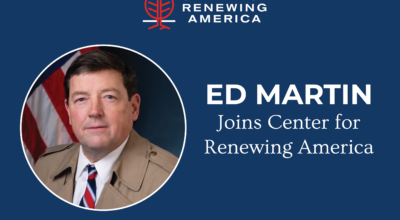
Former Trump DOJ Official Ed Martin Joins Center for Renewing America As Distinguished Fellow
Today the Center for Renewing America (CRA), founded by White House Office of Management and Budget Director Russ Vought, announced that Edward R. Martin Jr., a veteran public servant and former senior official in the Trump Administration’s Department of Justice, will join the organization as a Distinguished Fellow.