
Primer: How the Senate Can Secure a SAVE Act Win
America is bigger than a single unelected staffer. It’s time for the Senate majority to recognize that truth, stop putting itself first, and finally prioritize the people from whom it derives its own legitimacy.
Synopsis
On July 20, 2026, the House of Representatives passed a clean continuing resolution (CR) extending government funding through December 4, 2026.1 Notably, House leadership did not include the SAVE America Act in that measure. As a result, that CR is not currently an option for a House-originated vehicle for attaching SAVE America legislation. That opportunity would arise again only if the Senate amended the CR and returned it to the House, absent any other measures. Accordingly, the principal legislative pathway examined in this primer is the separate reconciliation process, while the CR remains a potential secondary vehicle only if it returns from the Senate.
Separately, the House has advanced its latest budget framework, “Reconciliation 3.0,” including a $10 billion instruction to the Committee on House Administration for a federal grant program that would provide states with resources to implement key components of the SAVE America Act.2 Although the SAVE America Act passed the House in February, it has stalled in the Senate due to senators who continue to short-circuit debate out of misplaced parliamentary reverence for the Senate’s modern cloture process.3 As the Center for Renewing America (CRA) has argued, the Senate has “perfected the art of motion without movement,” with issues of significant national importance frequently being run aground beneath the silent filibuster of cloture.4 This is an untenable dynamic both for the health of our constitutional republic and for the long-term integrity of our institutions.
Brief Background: The SAVE America Act
The SAVE America Act is the most consequential election integrity bill in generations.5 The three core common-sense provisions in the bill are:
- Required proof of citizenship to register to vote in federal elections.
- Required photo identification to cast a ballot in federal elections.
- Automatic removal of individuals from federal voter rolls whenever a state receives documentation or verified information that a registrant is not a U.S. citizen.
Polling has consistently shown that the legislation’s provisions enjoy significant support among the electorate, with 80 percent of Americans backing voter ID requirements and nearly 85 percent supporting proof-of-citizenship requirements.6 This broad-based support for the policies embedded in the SAVE America Act is extremely relevant amid the broader collapse in public confidence in U.S. elections. Recent polling this past spring showed that 50 percent of Americans believe it is likely or very likely voter fraud will occur in November’s elections, and more than 1 in 3 Americans express little to no confidence in their state and local governments to conduct fair and accurate elections.7 This collapse in trust stretches into nearly every institution in the nation, many of which remain at or near record lows, as reflected in the latest Gallup survey data.8
And yet, despite the immense popularity of the SAVE America Act’s provisions with the electorate and its clear potential to restore trust in key institutions, some senators appear far more committed to upholding self-imposed parliamentary obstacles to prevent its passage, which will only further erode trust in Congress while doing nothing to shore up faith in election outcomes. The irony is that while some might claim that “there are not the votes to nuke the filibuster, and there aren’t going to be 10 Democrat votes to all of a sudden support the SAVE America Act,” that claim itself is an admission that no process is even occurring.9
As the former Senate staffer and procedural expert James Wallner recently pointed out, the fact that neither side is acting on the bill is the real cause of the gridlock over the SAVE America Act. The Senate minority is not filibustering, holding the floor, or expending effort to prevent the majority from passing the bill. Likewise, the Senate majority is not forcing the minority to debate, hold the floor, or exhaust the opposition’s ability to otherwise stop the bill.10 Therefore, the Senate’s cloture process serves as a de facto minority veto over almost every consequential piece of legislation that comes out of the House, with just a few notable exceptions.
Under this existing dynamic, the “world’s most deliberative body” is, in fact, not deliberating. It is simply hiding its inaction behind procedural jargon that the vast majority of American citizens neither understand nor care about.
Fortunately, there are pathways out of the morass.
The Reconciliation Opportunity
With the House pursuing a separate reconciliation framework that would connect funding for election-integrity measures to components of the SAVE America Act, an opportunity to bypass the self-imposed parliamentary obstacles remains available. There are two primary paths that are available to force a vote on passage of the SAVE America Act in the Senate ahead of the November elections.
The First Path: Addressing the Filibuster Gridlock
A. Using the Talking Filibuster
Employing the talking filibuster—the approach championed by Senator Mike Lee (R-UT)—should be the most attractive to the Senate majority because it adheres to existing institutional rules and preserves the parliamentary processes that some senators are using as an excuse not to take up the bill. As CRA has explained before, the talking filibuster is a long-standing practice for ending debate in the Senate.11 Because the Senate operates on the principle of unlimited debate, floor discussion of legislation can only end when there is unanimous agreement that every senator has had the opportunity to speak for or against the bill. This means that, in theory, a group of senators could hold the floor indefinitely to prevent debate from ending and a vote on a bill from moving forward.
This was how the Senate operated from 1806 until 1917, when the cloture procedure was created with Rule XXII. Cloture was set at a sixty-seven-vote threshold until 1975, when the Senate lowered it to a sixty-vote supermajority to end debate.12 Importantly, the addition of cloture did not erase the prior process of the talking filibuster. It is still part of the Senate rules.
Under this approach, Thune would make the SAVE America Act the pending business of the Senate and not file a cloture petition. When that occurs, indefinite debate begins. However, because Rule XIX limits each senator to two speeches per legislative day (which is not a calendar day but instead the time between when the Senate convenes and adjourns), every member of the minority would be limited to two indefinite speeches to oppose the bill. These speeches could last hours or days depending on a senator’s stamina, and if staggered could theoretically filibuster the SAVE America Act for weeks or months.
During this period, the minority would also use parliamentary tactics, such as quorum calls and motions to adjourn, to bypass the majority and stop the bill. If the Senate majority can outlast the minority opposition’s speeches and parliamentary tactics or exhaust enough of the opposition to sign a cloture petition, then a final vote would transpire at just a fifty-one-vote simple majority threshold.13
This Senate tradition was dismissed by one senator as “naivete or a desire to get more likes on a social media post, maybe both.”14 That comment underscores the unfortunate reality that some senators either do not understand the rules of their own chamber or are unwilling to do the work they were elected to do.
B. Eliminating the Cloture Rule
i. Formal Amendment of Senate Rules
One way to remove the cloture rule is direct amendment. The Senate may change the text of Rule XXII itself. But because the rule currently requires two-thirds of senators present and voting to invoke cloture on a motion to amend the rules, the formal route is intentionally burdensome.15
ii. Majority Control Through Precedent (the “Nuclear” Option)
An alternative measure is precedent. A senator raises a point of order asserting that cloture on legislation should be decided by simple majority, the chair rules under existing precedent, and a majority votes not to sustain the chair. That is the method commonly labeled the “nuclear option,” though in legal terms it is better understood as precedent-making through appeal.16 The Senate already used this device in 2013 and 2017.17 A majority could use the same procedural logic for removing the cloture rule for passing ordinary legislation.
The Second Path: Overruling the Parliamentarian
President Trump has pointed out in multiple recent social media posts that the Senate parliamentarian has become one of the primary excuses for important public policies not moving forward in the Senate.18 The parliamentarian is little more than an institutional bureaucrat who provides advice to senators on parliamentary procedure, including the vaunted Byrd Rule. Setting aside debates over whether the SAVE America Act can pass the so-called “Byrd bath” as part of the reconciliation process, the reality is that the Senate parliamentarian does not get to veto the will of the people.
While it is perfectly acceptable to routinely take the parliamentarian’s advice into consideration, the final determination must come from the Senate itself, not an unelected bureaucrat who holds no constitutional power or office. Simply put, the parliamentarian does not rule; she advises. And because the Senate creates its own rules under Article I of the Constitution, it has every right to make a separate determination.
In the case of the SAVE America Act, if the reconciliation package ultimately comes to the Senate floor containing both the bill’s substantive provisions and associated funding, the vice president can sit in the chair and, if necessary, issue a ruling contrary to the parliamentarian’s advisory opinion regarding the bill’s eligibility for reconciliation. Article I, Section 3 of the Constitution designates the vice president as president of the Senate, vesting him with the constitutional authority to preside over the Senate.19 Although the Senate parliamentarian advises the presiding officer on the application of Senate rules, including the Congressional Budget Act and the Byrd Rule, the parliamentarian possesses no constitutional or statutory authority to render binding decisions. Rather, the constitutional authority to rule on questions of order rests with the chair.
If the President of the Senate presiding over the chamber determines that the reconciliation package satisfies the applicable procedural requirements, that ruling becomes the judgment of the chair unless a majority of senators votes to overturn it on appeal. If sustained by a majority of the Senate, the chair’s ruling would permit the reconciliation package to proceed under expedited procedures requiring only a simple majority for passage. This would ensure that the bill could pass with only fifty-one votes.
From a reconciliation perspective, a determination that the SAVE America Act does not violate the Byrd Rule is neither a constitutional issue nor, fundamentally, a legal issue—it is ultimately a play call that must be made by the Senate itself. While the Byrd Rule is indeed codified in statute under 2 U.S.C. § 644, the determination of what is deemed extraneous and therefore subject to a sixty-vote threshold is ultimately a determination made by senators, not by an unelected staffer.
As Americans rapidly lose trust in election outcomes and their overarching societal institutions, the Senate must stop the bleeding. The substance of the SAVE America Act supersedes a handful of senators’ reverence for procedural dogma. Passage and implementation of the bill will restore trust in our elections, which is essential to the very functioning of our constitutional republic.
Conclusion
With the House advancing a new reconciliation framework, the next major opportunity to secure passage of the SAVE America Act lies with congressional Republicans in the Senate, who must decide whether the upper chamber will use the procedural tools already available to force consideration of the legislation. Processes must be put in place to enhance transparency and reassure Americans that they can trust the outcomes of the votes they cast for those who represent them in their constitutional republic.
The stakes could not be higher. When people lose faith in these outcomes, existential issues percolate, threatening the survival of the republic: the exacerbation of the power and influence of anti-American extremists, widespread apathy, and loss of interpersonal trust among neighbors and fellow citizens. But America is bigger than an arbitrary Senate rule. America is bigger than a single unelected staffer. It’s time for the Senate majority to recognize that truth, stop putting itself first, and finally prioritize the people from whom it derives its own legitimacy.
Endnotes
1. H.R. 9770, 119th Cong. (2026). https://www.congress.gov/bill/119th-congress/house-bill/9770
2. Kochi, S. (July 15, 2026). “House Republicans Unveil $95B Reconciliation Package Framework,” The Hill. https://thehill.com/homenews/house/5969201-house-republicans-reconciliation-budget-resolution/.
3. McPherson, L. (June 23, 2026). “Trump, Senate Republicans to Hash Out Internal Debate Over Preelection Priorities,” The Washington Times. https://www.washingtontimes.com/news/2026/jun/23/trump-senate-republicans-hash-internal-debate-preelection-priorities/.
4. Miller, W. (June 18, 2026). “Primer: America First, Not Senate First,” Center for Renewing America. https://americarenewing.com/issues/primer-america-first-not-senate-first/.
5. Eckman, S., Garrett, S., and Whitaker, P. (February 24, 2026). “Safeguard American Voter Eligibility Act (SAVE America Act) and Federal Voter Registration Policy and Law,” Congressional Research Service. https://www.congress.gov/crs-product/IF12902.
6. Press Release (March 3, 2026). “Another New Poll Shows Massive Support for SAVE America Act,” The White House. https://www.whitehouse.gov/releases/2026/03/another-new-poll-shows-massive-support-for-save-america-act/.
7. Press Release (March 11, 2026). “Election Security, March 2026,” Marist Poll. https://maristpoll.marist.edu/polls/election-security-march-2026/.
8. Saad, L. (July 14, 2026). “Confidence in U.S. Institutions Remains Near All-Time Low,” Gallup. https://news.gallup.com/poll/712436/confidence-institutions-remains-near-time-low.aspx.
9. Supra note 4.
10. Wallner, J. (July 14, 2026). “SAVE America Act Reveals What Really Causes Senate Gridlock,” Legislative Procedure. https://www.legislativeprocedure.com/blog/2026/7/14/save-america-act-reveals-what-really-causes-senate-gridlock.
11. CRA Staff (February 6, 2026). “Explainer: The Talking Filibuster,” Center for Renewing America. https://americarenewing.com/issues/explainer-the-talking-filibuster/.
12. Ibid.
13. Ibid.
14. Supra note 4.
15. Standing Rules of the Senate, Rule XXII, S. Doc. No. 113-18, at 16 (2013).
16. Congressional Research Service (December 12, 2016). “Changing the Senate Cloture Rule at the Start of a New Congress,” Congressional Research Service, https://www.congress.gov/crs-product/R44709.
17. See U.S. Senate Roll Call Vote, 113th Cong., 1st Sess., Vote No. 242 (November 21, 2013); see also U.S. Senate Roll Call Vote, 115th Cong., 1st Sess., Vote No. 109 (April 6, 2017).
18. Dennis, S. (June 8, 2026). “Trump Urges Thune to Fire US Senate Rules Referee ‘Immediately,’” Bloomberg. https://www.bloomberg.com/news/articles/2026-06-08/trump-urges-thune-to-losefire-us-senate-rules-referee-immediately
19. U.S. CONST. art. I, § 3, cl. 4.
Referenced Documents

Related Posts
Can Congress Seat a Member-Elect Who Vows to Destroy our Constitution?
The November 2026 election could produce a member-elect of the House of Representatives who belongs to an organization and adheres to an ideology that has expressly advocated destroying significant components of the existing constitutional structure and who has personally acted to seek those ends.
CRA Submits Comment Supporting Census Bureau’s Proposed Rule
The proposed rule is an important step toward de-weaponizing the decennial
Census. For too long, the Census has been treated as an all-purpose statistical
product rather than as a distinct constitutional function that determines the
allocation of political representation in the United States.
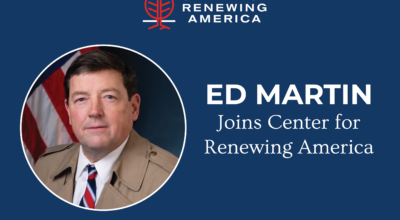
Former Trump DOJ Official Ed Martin Joins Center for Renewing America As Distinguished Fellow
Today the Center for Renewing America (CRA), founded by White House Office of Management and Budget Director Russ Vought, announced that Edward R. Martin Jr., a veteran public servant and former senior official in the Trump Administration’s Department of Justice, will join the organization as a Distinguished Fellow.