
Primer: The Need for a National Framework on Artificial Intelligence
The United States stands at a crossroads in the AI era. A fragmented, state-by-state approach to AI governance risks stifling innovation, ceding technological supremacy to Communist China, and allowing progressive activists to embed their ideological priorities into the foundational tools shaping our future.
Overview
Artificial intelligence (AI) is the defining technology of the twenty-first century. It has the potential to help reshape the American way of life for the better or to become a weapon in the hands of Communist China and the radical left. The rapid growth of AI demands a unified national framework rooted in American sovereignty. Fragmented state-by-state AI governance and regulation will stagnate innovation and ensure that Communist China has an edge in the race to develop cutting-edge AI technologies. President Donald Trump’s 2026 National AI Policy Framework rightly calls for federal leadership: a single, America First standard that protects children, empowers parents, secures America’s technological edge, and preempts the regulatory patchwork that enables America’s chief geopolitical foe.
The Threat of China and the Radical Left
The Center for Renewing America (CRA) has argued that AI development is a geopolitical necessity. In 2024, China’s commercial and academic AI sectors made significant progress on large language models and reasoning models, narrowing the performance gap with leading American systems.1 China’s military–civil fusion strategy channels civilian AI innovation directly into defense applications.2 If the United States does not take AI development seriously, the world that results from Chinese AI dominance will be one in which Western values are significantly diminished.3 China is building AI to control political narratives in its favor and suppress political freedom.4
On the home front, the foundational models that underlie modern AI are built by a small number of firms: Anthropic, OpenAI, xAI, Google DeepMind, and Meta’s AI division.5 These companies make daily decisions about training data, alignment targets, deployment boundaries, and value encoding that function as de facto cultural legislation.6 The radical left has captured institutions within the private sector, including large tech firms.7 If it succeeds in capturing all the firms developing AI platforms, AI will be controlled by progressives and used to advance progressive ends. This will especially be the case if left-wing states like California, where AI development is already heavily concentrated, end up taking control over AI policy.8 To prevent this, Congress should codify the president’s framework to prevent Chinese dominance and political subversion.
National Policy Framework for Artificial Intelligence and CRA Reforms
President Trump’s National AI Policy Framework is divided into multiple categories and includes several legislative recommendations. It advises that Congress should preempt state AI laws to ensure a minimally burdensome national standard.9 This national standard would respect key principles of federalism and not preempt traditional police powers retained by states.10 The framework would also ensure that states would not be permitted to regulate AI development because it is an interstate issue with implications for both foreign policy and national security.11
If Congress does not implement the Trump administration’s proposed framework, states will begin implementing discordant regulatory policies and effectively cede national AI policy to left-wing states, which are already trying to weave diversity, equity, and inclusion (DEI) concepts into AI regulation. For example, The American Conservative reports that in 2023, New York City passed a law requiring businesses to conduct an “annual bias audit” of all AI tools related to employment, to detect any disparate impact against protected groups.12 In 2024, Illinois amended its Human Rights Act, making it a civil rights violation for any employer to use AI that has a discriminatory effect, and in 2025, California made it unlawful for employers to use any “automated-decision system” that produces a disparate impact on protected groups in hiring, promotion, or firing.13 The state of Colorado also recently attempted to embed racial quotas into AI algorithms, a move that was challenged in federal court by Elon Musk’s xAI and the Department of Justice.14 State-by-state fragmentation of regulation, along with DEI social experiments, could make innovation in the AI sector nearly impossible and give China a critical advantage in the race to build the most advanced AI system.
The Trump administration’s framework includes vital reforms that will ensure the United States remains at the forefront of AI development, and many of these align with previous CRA proposals. The administration argues that Congress should not create a new federal rulemaking body to regulate AI but instead should support the development and deployment of sector-specific AI applications through existing regulatory bodies with subject-matter expertise and industry-led standards.15 This approach would allow room for the AI sector to grow and innovate. The framework also calls for Congress to build on actions taken by the Trump administration to protect children, including the historic signing of the Take It Down Act, a key initiative of First Lady Melania Trump to protect both children and adults from deepfake abuse.16 In a previous paper, CRA advocated for expanding the Take It Down Act.17 Congress could consider adopting explicit child-centered provisions along with mandating platform compliance audits, requiring preservation of evidence for law enforcement, and imposing escalating penalties for noncompliance.18
The Trump administration has also urged Congress to establish commercially reasonable, privacy-protective age-assurance requirements (such as parental attestation) for AI platforms and services likely to be accessed by minors.19 CRA has advocated for age verification laws to protect minors from the harmful impacts of online pornography; Congress could consider adopting similar restrictions for AI platforms.20
The administration advises that Congress should continue to carefully monitor the development of copyright precedents and enforcement in the courts and evaluate whether, due to novel AI considerations, additional action is needed to fill potential gaps or provide additional protections for content creators.21 CRA has argued that Congress could enact a national consent-first standard for the use of creative or personal data in AI training and generation to preserve human authorship and autonomy.22 This standard would reinforce the principle that human creators, not algorithms, should retain control over how their works are used and adapted.
Additionally, the administration’s framework calls for Congress to prevent the U.S. government from coercing technology providers, including AI providers, to ban, compel, or alter content based on partisan or ideological agendas.23 CRA has made the case against a European-style Digital Services Act (DSA).24 Launched in 2022, the DSA has changed the character of European cyberspace.25 A range of actors, from states to nongovernmental organizations, now have the power to report violations and initiate litigation against social media platforms if they fail to fulfill their new legal obligations to remove posts and implement algorithmic governance techniques.26 The regulation of online speech almost always favors established parties and progressive causes, and it is poised to become even more powerful if progressives set the terms for AI use and development. Congress should consider the administration’s safeguards in this area and protect free speech.
Congressional Considerations
Several members of Congress have introduced stand-alone bills in the 119th Congress that address aspects of the administration’s framework. For example, Senator Ted Cruz (R-TX) recently introduced the CHATBOT Act, which would require AI companies to establish “family accounts” for parents to manage their children’s access to and use of AI chatbots.27 Senator Josh Hawley (R-MO) also recently introduced the GUARD Act, which would ban AI companies from providing AI companions that simulate interpersonal relationships or emotional interactions to minors, along with imposing criminal penalties for companies whose AI chatbots engage in sexually explicit conduct with minors or solicit minors to commit self-harm or violence.28 Senator Marsha Blackburn (R-TX) has also been circulating a proposal called the TRUMP AMERICA AI Act, which addresses certain protections as well.29
Congress still has time before the midterm elections to address the Trump administration’s AI framework even more comprehensively. House Speaker Mike Johnson (R-LA) in March endorsed Trump’s plan for AI and has called on Congress to pass legislation that codifies the framework.30 It is important for Congress not to deviate from the president’s plan because any loopholes could weaken the national standard and cause setbacks in the race against China.
An Additional Consideration
CRA recently articulated that the United States should lead the creation of an international framework to restrict the development of AI-driven genetic manipulation.31 American lawmakers ought to consider ensuring that the natural course of function of the human condition is preserved and prevent progressives from using AI-enabled genetics and reproductive technology to influence family formation, which is already in crisis.32
Conclusion
The United States stands at a crossroads in the AI era. A fragmented, state-by-state approach to AI governance risks stifling innovation, ceding technological supremacy to Communist China, and allowing progressive activists to embed their ideological priorities into the foundational tools shaping our future. The Trump administration’s 2026 National AI Policy Framework offers the clear, decisive federal leadership required: a unified America First standard that safeguards national security, protects children and families, upholds free speech, preserves human creativity, and prevents regulatory capture by left-wing states.
Congress must act swiftly to codify this framework before the patchwork of conflicting state laws—laden with DEI mandates, bias audits, and disparate-impact rules—becomes permanent. By preempting inconsistent state regulations on AI development while respecting traditional state police powers, supporting sector-specific oversight, strengthening age-appropriate safeguards, and rejecting European-style speech controls, lawmakers can unleash American ingenuity and secure America’s competitive edge. Congress has the opportunity—and the responsibility—to pass comprehensive legislation aligned with President Trump’s vision.
Endnotes
1. Redemer (May 20, 2026). “Dominion of the Made: AI, America, and the Stewardship of What Comes Next,” Center for Renewing America. https://americarenewing.com/issues/dominion-of-the-made-ai-america-and-the-stewardship-of-what-comes-next/
2. Ibid.
3. Ibid.
4. Ibid.
5. Ibid.
6. Ibid.
7. Video (April 12, 2021). “Russ Vought: We Must Remove Benefits for Woke Corporate America,” Center for Renewing America. https://americarenewing.com/we-must-remove-benefits-for-woke-corporate-america/
8. Bokhari (May 13, 2026). “Democrats Weaponize AI Regulation to Push DEI,” The American Conservative. https://www.theamericanconservative.com/democrats-weaponize-ai-regulation-to-push-dei/
9. Legislative Recommendation (March 2026). “National Policy Framework on Artificial Intelligence,” The White House. https://www.whitehouse.gov/wp-content/uploads/2026/03/03.20.26-National-Policy-Framework-for-Artificial-Intelligence-Legislative-Recommendations.pdf
10. Ibid.
11. Ibid.
12. Bokhari (May 13, 2026). “Democrats Weaponize AI Regulation to Push DEI,” The American Conservative. https://www.theamericanconservative.com/democrats-weaponize-ai-regulation-to-push-dei/
13. Ibid.
14. Ibid.
15. Legislative Recommendation (March 2026). “National Policy Framework on Artificial Intelligence,” The White House. https://www.whitehouse.gov/wp-content/uploads/2026/03/03.20.26-National-Policy-Framework-for-Artificial-Intelligence-Legislative-Recommendations.pdf
16. Ibid.
17. Osborne (March 10, 2026). “Primer: Drawing the Line Around Innocence in the Generative AI Age” Center for Renewing America. https://americarenewing.com/issues/primer-drawing-the-line-around-innocence-in-the-generative-ai-age/
18. Ibid.
19. Legislative Recommendation (March 2026). “National Policy Framework on Artificial Intelligence,” The White House. https://www.whitehouse.gov/wp-content/uploads/2026/03/03.20.26-National-Policy-Framework-for-Artificial-Intelligence-Legislative-Recommendations.pdf
20. Candeub (July 21, 2023). “Online Age-Verification: Protecting Children and Privacy,” Center for Renewing America. https://americarenewing.com/issues/identity-on-the-internet-protecting-children-and-privacy-and-building-a-proof-of-humanity-regulatory-regime-for-an-ai-driven-internet/
21. Legislative Recommendation (March 2026). “National Policy Framework on Artificial Intelligence,” The White House. https://www.whitehouse.gov/wp-content/uploads/2026/03/03.20.26-National-Policy-Framework-for-Artificial-Intelligence-Legislative-Recommendations.pdf
22. Osborne (December 5, 2025). “Primer: A Society in Flux: Copycats, Creativity, and the Future of Artificial Intelligence Governance,” Center for Renewing America. https://americarenewing.com/issues/primer-a-society-in-flux-copycats-creativity-and-the-future-of-artificial-intelligence-governance/
23. Legislative Recommendation (March 2026). “National Policy Framework on Artificial Intelligence,” The White House. https://www.whitehouse.gov/wp-content/uploads/2026/03/03.20.26-National-Policy-Framework-for-Artificial-Intelligence-Legislative-Recommendations.pdf
24. Pinkoski (October 27, 2025). “Online Censorship and AI Mass Surveillance: How the EU Has Captured the Digital Era and Why America Must Challenge It,” Center for Renewing America. https://americarenewing.com/issues/online-censorship-and-ai-mass-surveillance-how-the-eu-has-captured-the-digital-era-and-why-america-must-challenge-it/
25. Ibid.
26. Ibid.
27. Press Release (April 28, 2026). “Cruz, Schatz, Curtis, Schiff Introduce New Bill Giving Parents Control Over Kids’ AI Chatbot Use,” Senate Commitee on Commerce, Science, and Transportation. https://www.commerce.senate.gov/press/rep/release/cruz-schatz-curtis-schiff-introduce-new-bill-giving-parents-control-over-kids-ai-chatbot-use/
28. Press Release (April 30, 2026). “Senator Hawley’s GUARD Act to Protect Kids from AI Chatbots Passes Committee Unanimously,” Office of Senator Josh Hawley. https://www.hawley.senate.gov/senator-hawleys-guard-act-to-protect-kids-from-ai-chatbots-passes-committee-unanimously/
29. Press Release (March 18, 2026). “Blackburn Releases Discussion Draft of National Policy Framework for Artificial Intelligence,” Office of Senator Marsha Blackburn. https://www.blackburn.senate.gov/2026/3/technology/blackburn-releases-discussion-draft-of-national-policy-framework-for-artificial-intelligence/3b3b6458-b6c7-478b-9859-374949586765
30. Press Release (March 20, 2026). “Johnson, Scalise, Guthrie, Jordan, Babin: House Will Work to Implement National AI Framework,” Office of Representative Mike Johnson. https://mikejohnson.house.gov/news/documentsingle.aspx?DocumentID=2860
31. Thibeau (December 4, 2025). “Stopping the New Adam: A Call for an AI Genetics Non-Proliferation Treaty,” Center for Renewing America. https://americarenewing.com/issues/stopping-the-new-adam-a-call-for-an-ai-genetics-non-proliferation-treaty/
32. Ibid.
Referenced Documents

Related Posts
Can Congress Seat a Member-Elect Who Vows to Destroy our Constitution?
The November 2026 election could produce a member-elect of the House of Representatives who belongs to an organization and adheres to an ideology that has expressly advocated destroying significant components of the existing constitutional structure and who has personally acted to seek those ends.
CRA Submits Comment Supporting Census Bureau’s Proposed Rule
The proposed rule is an important step toward de-weaponizing the decennial
Census. For too long, the Census has been treated as an all-purpose statistical
product rather than as a distinct constitutional function that determines the
allocation of political representation in the United States.
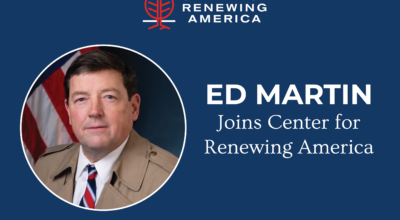
Former Trump DOJ Official Ed Martin Joins Center for Renewing America As Distinguished Fellow
Today the Center for Renewing America (CRA), founded by White House Office of Management and Budget Director Russ Vought, announced that Edward R. Martin Jr., a veteran public servant and former senior official in the Trump Administration’s Department of Justice, will join the organization as a Distinguished Fellow.