

Primer: Statistical Policy Directive No. 15 — An Instrument of State-Sanctioned Racism
The aim of an OMB review, therefore, should be to stop the weaponization of SPD No. 15 by ending the prioritization of disparate impact and race essentialism in federal data collection. Rolling back the alterations made in the Clinton and Biden administrations is a good place to start because it undermines the very structure of DEI dogma perpetuated by existing statistical analyses.
Background
The woke and weaponized agenda of the ruling class presents an existential threat to the American republic. For that reason, the Center for Renewing America (CRA) has committed to a sustained effort to expose and eliminate the state-sanctioned racism embedded in so-called diversity, equity, and inclusion (DEI) programs, critical race theory, and the broader web of woke neo-Marxist ideologies that have captured America’s schools, corporations, universities, and federal bureaucracy. CRA has published multiple blueprints for ending state-sanctioned racism wherever it is found in key institutions of American life,1 including a first-of-its-kind budget targeting woke and weaponized components within the federal bureaucracy.2
CRA has also exposed how the Census Bureau’s use of differential privacy distorted the 2020 census count, contributed to the most inaccurate census in modern history, tilted the political scales in favor of progressives for redistricting, and attempted to nullify President Donald Trump’s attempts to add the citizenship question to the census.3 Census reform, however, cannot stop at the way the government counts people. It must also confront the questions of how the government decides to classify them and what purpose such classifications serve. This process was most recently altered in 2024 under the Biden administration, which implemented revisions to Statistical Policy Directive (SPD) No. 15 to further expand race essentialism into the federal government’s data operations.
Analysis
The Office of Management and Budget (OMB) oversees the collection of race and ethnicity data through SPD No. 15: “Standards for Maintaining, Collecting, and Presenting Federal Data on Race and Ethnicity.”4 SPD No. 15 intends to “ensure the comparability of race and ethnicity across Federal datasets and to maximize the quality of that data by ensuring that the format, language, and procedures for collecting the data are consistent.”5 This directive affects the presentation of population demographics in federal statistics, including the American Community Survey and the census.6 The Census Bureau, like all other federal statistical agencies, is required to follow SPD No. 15.7
Through statutory and administrative processes, OMB updates existing SPDs, which include technical evaluation of current standards, analysis to close gaps, and consideration of public comments on ways to improve the standards.8 All final decisions on changes to an SPD are made by OMB.9 SPD No. 15 was developed in 1977 to help enforce civil rights laws and originally contained the following racial categories:10
- American Indian or Alaskan Native
- Asian or Pacific Islander
- Black
- White
It also established these ethnic categories:11
- Hispanic origin
- Not of Hispanic origin
In 1997, the Clinton administration revised SPD No. 15 to include five minimum categories for race data: American Indian or Alaska Native, Asian, Black or African American, Native Hawaiian or Other Pacific Islander, and White.12 Also included were two categories for data on ethnicity: “Hispanic or Latino” and “Not Hispanic or Latino.”13 According to the U.S. Census Bureau, “for data collected directly from respondents, the revised 1997 standards required two separate ethnicity and race questions, with the ethnicity question asked before the race question.”14 It also stated that Hispanic or Latino respondents may be of any race and gave respondents the opportunity to report multiple races.15 The stated reason for the revision was “increasing criticism from those who believe that the minimum categories set forth in Directive No. 15 do not reflect the increasing diversity of the Nation’s population that has resulted primarily from growth in immigration and in interracial marriages.”16
Nearly three decades later, under the Biden administration, OMB revised SPD No. 15 again. The U.S. Census Bureau notes that this revision includes the following:17
- using a combined race/ethnicity question with coequal categories and encouraging respondents to select as many options as apply
- adding Middle Eastern or North African as a new minimum category
- requiring the collection of additional detail beyond the minimum required race and ethnicity categories for most situations
- updating definitions, terminology, and guidance to agencies on the collection and presentation of data
The Biden administration’s cited reasons for this revision were “large societal, political, economic, and demographic shifts in the United States, including increasing racial and ethnic diversity, a growing number of people who identify as more than one race or ethnicity, and changing immigration and migration patterns.”18 It is important to note that the Biden administration had a de facto open-border policy and allowed large-scale illegal immigration into the United States.19 The administration also attempted to entrench DEI concepts in almost every aspect of the federal government.20
By expanding SPD No. 15 “to better reflect the diversity of the Nation,” the Biden administration created a more elaborate apparatus for classifying citizens by race, and that apparatus remains the foundation on which state-sanctioned racism is built. DEI offices cannot impose racial targets and racially drawn congressional districts cannot be defended in court without an authoritative federal scheme that first sorts Americans into the relevant boxes. The post-Clinton SPD No. 15 is that scheme. The more finely it organizes the population into multiple categories, the more grievances can be generated, the more woke programs can be promulgated, and the more aggressively the government can be primed to engineer outcomes predicated on race essentialism.
Further, the expanded SPD No.15 under Biden requires that its standards “be used by all Federal agencies for civil rights and other compliance reporting from the public and private sectors and all levels of government.”21 The mandate to infuse race essentialism into the federal bureaucracy and the private sector for the promulgation of “civil rights” is a barely disguised dictate to enact neo-Marxist DEI initiatives into every aspect of American society. It should raise alarms among policymakers that these new categories will soon be deployed in the 2030 Decennial Census and other federal data collection surveys.
Louisiana v. Callais and the 2030 Census
Amid the backdrop of SPD No.15 is the Supreme Court’s recent opinion in Louisiana v. Callais, which voided Louisiana’s congressional map and declared the use of race in the creation of congressional districts to be unconstitutional.22 In its Callais opinion, the Court said that creators of congressional maps now have to “disentangle race from politics.”23 While Louisiana v. Callais effectively eliminates explicit racial gerrymandering, it also sends the message that the judiciary will no longer rubber-stamp the reflexive use of racially charged public policy prerogatives among the increasingly radical Washington political class. The executive branch has taken significant steps to eliminate the use of race and racist quotas from the government. The Trump administration has made substantial progress in this area by issuing numerous executive actions eliminating DEI within the executive branch.24
Nevertheless, it is vital to ensure that the looming 2030 Census does not defraud American voters through deceptive algorithms such as differential privacy or racial profiling directed by preexisting policy initiatives. This means eliminating directives designed to back-channel race essentialism throughout the federal bureaucracy, such as the 2024 revision of SPD No. 15, which encourages and empowers ideological radicalism to flow downstream into America’s cultural institutions through race-based data collection. Efforts to eliminate the bureaucracy’s surreptitious DEI agenda must be accelerated before operations to conduct the next Decennial Census begin.
Considerations for the Trump Administration
Since all final decisions on changes to an SPD are ultimately determined by OMB, the agency should consider announcing a formal review of SPD No. 15 as soon as possible. Such reviews and prospective changes must go through the Administrative Procedures Act (APA), which means that time is of the essence. The APA process will take months because of the required notice-and-comment period. The Census Bureau’s 2030 Operational Plan makes clear its intentions to “implement OMB’s updated 2024 race and ethnicity standards in the 2027 American Community Survey and the 2030 Census.”25 This same plan states its intention to increase “the level of race and ethnicity detail for the estimates.”26 The Census Bureau is openly defying the Trump administration’s sustained efforts to eliminate DEI and race essentialism in the federal agencies.
The aim of an OMB review, therefore, should be to stop the weaponization of SPD No. 15 by ending the prioritization of disparate impact and race essentialism in federal data collection. Rolling back the alterations made in the Clinton and Biden administrations is a good place to start because it undermines the very structure of DEI dogma perpetuated by existing statistical analyses. This would help ensure that federal data standards are not structured to produce, justify, or facilitate neo-Marxist decision-making that caters to a societally destructive “oppressed versus oppressor” dichotomy along racial lines.
Conclusion
The Trump administration has made great progress in ending DEI and state-sanctioned racism. The revisions made by previous administrations to SPD No. 15 are antithetical to that progress. Reviewing and paring back the Clinton- and Biden-era expansions would not erase the government’s ability to collect information; instead, it would reorient SPD No. 15 to ensure that data-collection procedures are consistent and fair. Further, it would ensure that the upcoming 2030 Census cannot continue to serve as an engine propelling DEI forward into the next decade. The existing paradigm entrenches radical progressive orthodoxies through race essentialism, thereby cementing a fundamentally destructive threat to the well-being of our constitutional republic into the core of the federal bureaucracy. Should the Trump administration act to end this woke and weaponized practice it will have our full support.
Endnotes
1. CRA Staff (May 5, 2021). “Primer: Ending State-Sanctioned Racism,” Center for Renewing America. https://americarenewing.com/one-pager-ending-state-sanctioned-racism/
2. CRA Staff (December 7, 2022). “A Commitment to End Woke and Weaponized Government: 2023 Budget Proposal,” Center for Renewing America. https://americarenewing.com/wp-content/uploads/2024/03/Budget-Center-for-Renewing-America-FY23.pdf
3. Miller and White (August 7, 2025). “The 2020 Census Fraud: How Differential Privacy Skewed Representation,” Center for Renewing America. https://americarenewing.com/issues/the-2020-census-fraud-how-differential-privacy-skewed-representation/
4. Knoedl (April 1, 2026). “Revisions to Statistical Policy Directive No. 15: Standards for Maintaining, Collecting, and Presenting Federal Data on Race and Ethnicity,”Congressional Research Service. https://www.congress.gov/crs-product/IN12304
5. Ibid.
6. Ibid
7. Ibid.
8. Ibid.
9. Ibid.
10. Ibid.
11. Ibid.
12. Ibid.
13. Ibid.
14. Census Bureau (December 20, 2024). “Updates to Race/Ethnicity Standards for Our Nation,” U.S. Census Bureau. https://www.census.gov/about/our-research/race-ethnicity/standards-updates.html
15. Ibid.
16. Office of Management and Budget, “Revisions to the Standards,” 58782. https://www.govinfo.gov/content/pkg/FR-1997-10-30/pdf/97-28653.pdf
17. Census Bureau (December 20, 2024). “Updates to Race/Ethnicity Standards for Our Nation,” U.S. Census Bureau. https://www.census.gov/about/our-research/race-ethnicity/standards-updates.html
18. Notice of Decision (March 29, 2024). “Revisions to OMB’s Statistical Policy Directive No. 15: Standards for Maintaining, Collecting, and Presenting Federal Data on Race and Ethnicity,” Federal Register, Vol. 89. No. 62. https://www.govinfo.gov/content/pkg/FR-2024-03-29/pdf/2024-06469.pdf
19. Miller and Schuster (November 8, 2024). “Primer: U.S. Deportations—A Longstanding & Normal Process,” Center for Renewing America. https://americarenewing.com/issues/primer-u-s-deportations-a-longstanding-normal-process/
20. CRA Staff (March 10, 2025). “Digging for DEI Dollars: Watchdog Report Identifies 460 Programs Across 24 Federal Agencies,” Center for Renewing America. https://americarenewing.com/issues/digging-for-dei-dollars-watchdog-report-identifies-460-programs-across-24-federal-agencies/
21. Notice of Decision (March 29, 2024). “Revisions to OMB’s Statistical Policy Directive No. 15: Standards for Maintaining, Collecting, and Presenting Federal Data on Race and Ethnicity,” Federal Register, Vol. 89. No. 62. https://www.govinfo.gov/content/pkg/FR-2024-03-29/pdf/2024-06469.pdf
22. Louisiana v. Callais, No. 24-109, slip op. at 3 (U.S. Apr. 29, 2026). https://www.supremecourt.gov/opinions/25pdf/24-109_21o3.pdf
23. Ibid.
24. Executive Order (January 20, 2025). “Ending Radical and Wasteful Government DEI Programs and Preferencing,” The White House. https://www.whitehouse.gov/presidential-actions/2025/01/ending-radical-and-wasteful-government-dei-programs-and-preferencing/
25. Census Bureau (July 2025). “2030 Census Operational Plan,” U.S. Census Bureau. https://www2.census.gov/programs-surveys/decennial/2030/program-management/planning/operational-plan/2030-census-operational-plan.pdf
26. Ibid.

Related Posts

Can Congress Seat a Member-Elect Who Vows to Destroy our Constitution?
The November 2026 election could produce a member-elect of the House of Representatives who belongs to an organization and adheres to an ideology that has expressly advocated destroying significant components of the existing constitutional structure and who has personally acted to seek those ends.
CRA Submits Comment Supporting Census Bureau’s Proposed Rule
The proposed rule is an important step toward de-weaponizing the decennial
Census. For too long, the Census has been treated as an all-purpose statistical
product rather than as a distinct constitutional function that determines the
allocation of political representation in the United States.
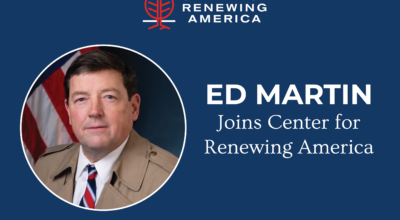
Former Trump DOJ Official Ed Martin Joins Center for Renewing America As Distinguished Fellow
Today the Center for Renewing America (CRA), founded by White House Office of Management and Budget Director Russ Vought, announced that Edward R. Martin Jr., a veteran public servant and former senior official in the Trump Administration’s Department of Justice, will join the organization as a Distinguished Fellow.