

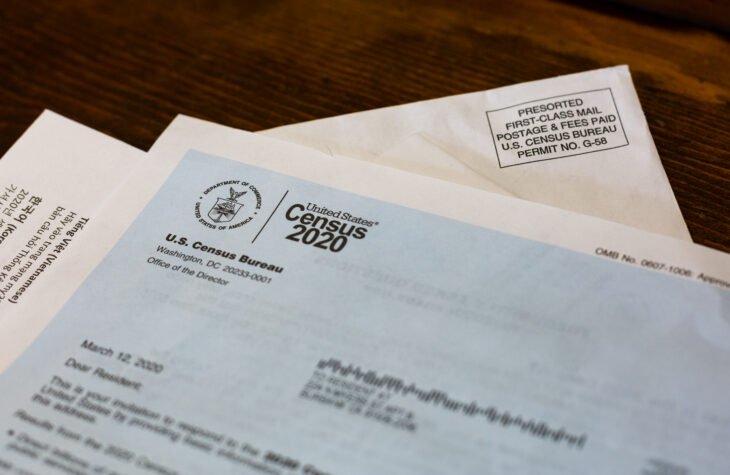
Executive Summary: Ending the Past Partisan Weaponization of the Census and Ensuring a Nonpartisan, Fair, and Transparent Process
The census has become a tool for shifting political power away from citizens. That trend can be reversed. If the reforms outlined below are adopted and every state draws its congressional maps to the full extent the law allows, the House of Representatives after the 2031 redistricting would sit at a ceiling of 261 Republicans to 174 Democrats, compared with 220 Republicans and 215 Democrats under the 2020 Census.
The Bottom Line
The census has become a tool for shifting political power away from citizens. That trend can be reversed. If the reforms outlined below are adopted and every state draws its congressional maps to the full extent the law allows, the House of Representatives after the 2031 redistricting would sit at a ceiling of 261 Republicans to 174 Democrats, compared with 220 Republicans and 215 Democrats under the 2020 Census. That number is not a partisan target worked backward to reach a biased goal. It is what representation looks like when the census is de-weaponized and the “actual Enumeration” is restored to its constitutional purpose. The full primer, “Ending the Past Partisan Weaponization of the Census and Ensuring a Nonpartisan, Fair, and Transparent Process,” lays out the constitutional arguments, the state-by-state results, and the methodology for this effort. This memo summarizes the case and the changes required to achieve a truly fair and transparent census process.
Executive Summary: Conducting a Fair and Transparent Census
The Problem
Every ten years, the census counts the population, and that count determines how the 435 seats in the House of Representatives and the allocation of votes in the Electoral College are divided among the states. Under current practice, the count makes no distinction between a natural-born citizen, a naturalized citizen, a green-card holder, and a person who entered the country unlawfully and is subject to removal at any moment. Each is counted identically and given equal weight in a state’s claim to federal representation. The result inverts the Constitution. A state that obstructs federal immigration enforcement is rewarded with more seats in Congress and more Electoral College votes than a state that follows the law. A state that cooperates with immigration enforcement is penalized. Political power is transferred from the citizens of one state to the citizens of another on the basis of a population that cannot lawfully vote, cannot lawfully remain, and owes no allegiance to the United States. No other area of federal law compensates states for frustrating a federal function.
The same distortion repeats inside each state. When districts are equalized by total residents rather than citizens, a citizen in a district with a large noncitizen population exercises substantially more influence over the selection of a representative than a citizen elsewhere in the same state. The state creates that inequality by law through a districting choice, even though an alternative population base is readily available.
The Supreme Court has never held that the Constitution requires any of these practices. In Trump v. New York, the court declined to rule on the question of whether unlawfully present aliens must be counted for apportionment. In Evenwel v. Abbott, it held that states may use total population for districting and expressly left open the question of whether they may use citizen population instead. Thus both questions remain open, and both should be answered in favor of citizens.
The Changes Required
Six reforms, taken together, restore a fair and transparent process. Each is developed at length in the primer:
1. Exclude unlawfully present aliens from the apportionment base. Count only citizens and lawful permanent residents when dividing House seats among the states. The Census Bureau has already proposed a rule to this effect for 2030. Note that at this stage, lawful permanent residents are included as a matter of legal strategy; the stronger constitutional position is that representation belongs to citizens alone, as argued in the primer, but we are reserving the right to elaborate on that position further for future work.
2. Eliminate differential privacy and other data falsification protocols. The 2020 count was deliberately altered in the name of privacy. No citizenship reform is meaningful while differential privacy or similar mechanisms manipulate the underlying numbers.
3. Restore the citizenship question. The decennial census has not asked every household about citizenship since 1950. The Supreme Court did not bar the question in 2019; it faulted the administrative process used to add it. A properly built record can withstand review.
4. Reinstate administrative-record matching. The census should not rely on self-reporting alone. Matching census responses against Social Security, IRS, State Department, and U.S. Citizenship and Immigration Services records can verify citizenship independent of a respondent’s candor.
5. Furnish citizen-population data as the federal redistricting dataset. Federal law requires a “total population” count for apportionment but does not impose that requirement on the data sent to states for redistricting. The Census Bureau can deliver citizen-population tabulations as the standard redistricting product, and Congress can amend the statute to make that standard explicit.
6. Draw congressional districts by citizen population. States should equalize districts by citizens rather than total residents so that every citizen’s vote carries equal weight. Congress has express authority over congressional elections and can mandate that standard to the fullest extent the Constitution permits.
Why the Process Is Fair
None of these reforms reward one party’s mapmakers over the other. They change who is counted and what population every state must equalize. The consequences follow from where citizens and noncitizens live, not from who holds the pen. The model behind the 261–174 figure treats both parties identically. Wherever a legislature controls a map, it is assumed to draw aggressively but durably, whether that legislature is Republican or Democratic. Where a court or commission draws the map, the projection stays close to the existing delegation. Run against 2020 data, the model reproduces the certified 2020 apportionment exactly in all fifty states, including New York’s loss of a seat by eighty-nine people.
It is important to note that the 261–174 figure is a ceiling: the maximum available if every assumption holds and every state redistricts to its durable limit. It is not a forecast of any election. The primer states each assumption plainly so a reader can check the reasoning or reject it at any point.
What Is at Stake
A citizen count is not a technical adjustment to a statistical program. It is the restoration of a first principle: American citizenship must mean something. For decades, government systems have blurred the line between citizen and noncitizen, extending the benefits of political membership while hollowing out the status from which those benefits are supposed to flow. Citizens now watch their political power being diluted because the law refuses to distinguish those who constitute the American political community from those who do not.
A self-governing republic cannot sustain that inversion. Citizenship carries obligations, confers rights, and establishes membership in the sovereign body from which legitimate government derives its authority. It must mean something, and our representational institutions should reflect that meaning. Restoring a citizen-centered census does more than correct a distorted process. It reaffirms the basic promise of republican government: Political power belongs, ultimately, to the American people.


Related Posts

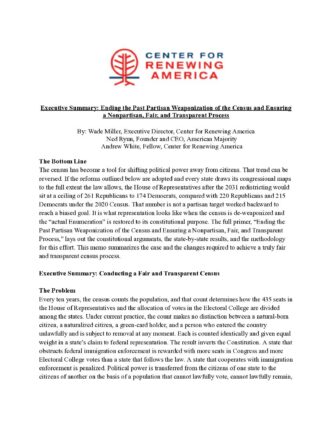
Executive Summary: Ending the Past Partisan Weaponization of the Census and Ensuring a Nonpartisan, Fair, and Transparent Process
The census has become a tool for shifting political power away from citizens. That trend can be reversed. If the reforms outlined below are adopted and every state draws its congressional maps to the full extent the law allows, the House of Representatives after the 2031 redistricting would sit at a ceiling of 261 Republicans to 174 Democrats, compared with 220 Republicans and 215 Democrats under the 2020 Census.
Primer: Ending the Past Partisan Weaponization of the Census and Ensuring a Nonpartisan, Fair, and Transparent Process
The Census Bureau recently proposed a rule that begins to make the same necessary corrections CRA supports by restoring meaning to residence, putting accuracy first, and limiting demographic questions that have increasingly burdened the constitutional count.

Can Congress Seat a Member-Elect Who Vows to Destroy our Constitution?
The November 2026 election could produce a member-elect of the House of Representatives who belongs to an organization and adheres to an ideology that has expressly advocated destroying significant components of the existing constitutional structure and who has personally acted to seek those ends.