
Primer: Additional Reforms Ahead of the 2030 Census to Counter the 2020 Census Fraud
Census fraud is a critical issue in the lead-up to the 2030 Census. Americans do not have accurate political representation due to operational failures, incompetence, and ideologically driven distortions within the bureau’s upper echelon.
Synopsis
The 2020 Census was the most inaccurate in modern American history. As the Center for Renewing America has detailed in previous analyses, significant counting errors and the implementation of differential privacy’s data falsification methodology ensure that the Census Bureau’s current operational posture defrauds American voters.1 Republishing the 2020 Census, eliminating differential privacy, and properly implementing regulatory guidance to establish a citizenship question remain of paramount importance before the 2030 Census to guarantee accurate representation for all Americans. However, the Census Bureau requires broader reforms beyond those addressing inaccuracies and deceptive algorithms stemming from the 2020 Census.
The Census Bureau needs both executive action and congressionally enacted statutory corrections to improve its operational processes for fulfilling its constitutional duty to properly count every citizen in the republic. These additional reforms, alongside the higher-priority fixes of eliminating differential privacy and adding a citizenship question, will begin to restore trust in the apportionment and redistricting process. Census fraud is real, and it must be rooted out before the next constitutionally mandated count.
The Census Bureau’s Operational Gaps
The purpose of the U.S. Census is to count the entire population of the United States and to place each person in his or her proper location as accurately and transparently as possible. These counts are critical for assessing political representation in the House of Representatives and the Electoral College. Census data also heavily impacts federal policy, directly shaping funding formulas and allocations for numerous welfare programs in education, health care, and housing. The first iteration of the bureau’s 2030 operational plan reveals numerous gaps and flaws that seem intended to move the train out of the station before reforms can be implemented to get the next census right.2
First and foremost, the operational plan makes no mention of the mistakes that caused undercounts and overcounts in fourteen states in the 2020 Census. Evaluations by outside entities and experts state that these errors resulted in a six-seat swing in the House of Representatives away from Republican-dominated states and toward Democrat-dominated states.3 The bureau’s failures to address these errors, explain how they occurred during the 2020 Census, and outline how it will avoid such mistakes ahead of the 2030 Census are the result of an entrenched bureaucracy that neglects its mission and the administration’s mandate.
The operational plan states that it intends to build on “innovations” in the 2020 Census for household enumeration. Differential privacy is not specifically mentioned in the document, though it is indirectly referenced as a “disclosure avoidance method.”4 The bureau only tacitly admits its failings by referencing the trade-offs that come from “statistical techniques to protect confidentiality” and the availability and utility of the statistics. This implies an awareness that differential privacy intentionally obscures the real data from everyone except the privileged few at the top.
Further, the bureau’s operational plan explicitly states that it seeks to improve on the disclosure avoidance techniques (i.e., differential privacy) employed in the last census to “enhance the robust privacy and confidentiality measures . . . used previously in the 2020 Census.”5 It also mentions the development of alternatives, but does not specify what those could be other than stating that they are soliciting feedback from stakeholders.
The emphasis of the operational plan is on efficiency and data quality; the accuracy of the count seems to be of secondary importance. This order of priorities is a clear indication that the bureau itself—under current leadership—does not seek to rectify the mistakes of the 2020 Census, is not interested in moving away from data falsification algorithms that deceptively move populations, and does not plan to add a citizenship question through the Administrative Procedures Act (APA).
The administration must appoint personnel who understand that this is an untenable approach and who believe that the current operational plan for the 2030 Census should be replaced with one that makes the policy changes necessary to rectify the mistakes of the previous census and restore confidence in the bureau’s process for future counts. This should be done as swiftly as possible.
Key Practical Reforms
Under new leadership, the bureau should—in addition to key priorities such as republishing the 2020 Census, eliminating differential privacy, and adding a citizenship question — address more practical issues related to the headcount. Key reforms include the following:
1. Restore the Count Question Resolution (CQR) Process: The CQR process enables local jurisdictions to correct errors in census data collection. However, the implementation of differential privacy effectively neutered this process because local jurisdictions could not distinguish between actual mistakes and intentional data falsification. While the restoration of CQR should, in theory, occur automatically once differential privacy is eliminated, the bureau should send a deliberate signal to local jurisdictions through a revamped operational plan for the 2030 Census that CQR is being bolstered to ensure that census fraud does not occur at scale as it did during the 2020 Census. This can be done through executive means.
Policy Note: The CQR program typically takes about two years to complete after publication of the redistricting data. This means that if the Department of Commerce instructs the bureau to republish the nondifferential privacy data from the 2020 Census, the final CQR errata will not be published until mid-2028 at the earliest. If the department does so immediately, this would still be one election cycle ahead of the 2030 Census, but the time to act is now.
2. Establish an Office of General Counsel: While new bureaucracy typically yields negative outcomes, this is an exception: Congress should fund the creation of an Office of General Counsel within the bureau. The mission of this office should be to investigate the likelihood that the bureau used improper or illegal methods to statistically adjust, impute, deduplicate, or resolve household status in the 2020 Census. All personnel assigned to the office should be Title 13–sworn to ensure they have access to the raw, unaltered data.
3. Publicly Correct Post-Enumeration Survey (PES) Imputations: The seeds of distrust in the census were sown when the bureau stated that the 2020 Census results were being delayed due to a “reasonableness” check program and deduplication process.6 In late 2020, the bureau reported that it had resolved 99.98 percent of all housing units nationwide.7 This means that no more than 0.02 percent of all housing units should have required a count imputation (a term for when the bureau is unable to attain direct or circumstantial evidence for a question on a census return and inserts, or imputes, an answer). In the results the bureau released six months later, count imputations had occurred in 0.9 percent of households.8 This is more than forty times the number of households that should have been eligible according to the bureau’s 2020 report, and it is the highest number of imputations ever recorded in a census.
Policy Note: As part of a necessary transparency initiative, the bureau should publish a detailed public explanation of the 2020 PES results, which prove that six congressional seats swung in a partisan direction that benefited mostly Democrat-dominated states and distorted representation in mostly Republican-dominated states.
4. Implement New Group Quarters Policies: The census is constitutionally designed to locate people for purposes of taxation and voting. Under the bureau’s current policy, people living in group quarters are counted where they are physically located rather than where they vote and pay taxes, undermining the “one person, one vote” standard the bureau purports to uphold. Instead, all military, dormitory, and prison populations should be counted at their permanent addresses where they vote and pay taxes. This reform will ensure that institutional populations do not artificially bolster the voting strength and representation of one party over another.
Policy Note: The preferred way to implement this policy is through an appropriations bill or a statutory change in Congress. However, the Department of Commerce can also issue new regulatory guidance that alters how group quarters are counted. This will require an APA notice-and-comment period.
5. Empower the Director: The current composition of the bureau insulates the bureaucracy from accountability through the deputy director and chief operating officer (COO) position. As currently constituted, the bureau’s structure requires all civil service employees to report to the COO rather than the director, making the position akin to a “permanent secretary” in a British-style bureaucracy. The effect is that the COO shields bureau employees from the president’s political policies. The COO position should be eliminated, and all non-senior employees within the COO’s office should be subject to a reduction-in-force notice. The senior administrative staff should be converted to Schedule C appointees and made to report directly to the director.
Policy Note: The current organization of the bureau stems from two Department of Commerce orders: DOO 35-2A and DOO 35-2B.9 These orders should be revised through the secretary’s office and by congressional statute to prevent future administrations from undoing these reforms.
Conclusion
Census fraud is a critical issue in the lead-up to the 2030 Census. Americans do not have accurate political representation due to operational failures, incompetence, and ideologically driven distortions within the bureau’s upper echelon. Weaponized government only works when unaccountable bureaucracies are allowed to act without consequences. Both the administration and Congress have the opportunity to place the right people in key positions and enact the right policies to ensure a fair and accurate count in future censuses.
Census fraud can and must be undone through deliberative and transparent actions that restore trust in the process. Time, however, is running out.
Endnotes
1. Miller, W. and White, A. (August 7, 2025). “Policy Brief: The Census Bureau Is Defrauding American Voters,” Center for Renewing America. https://americarenewing.com/issues/policy-brief-the-census-bureau-is-defrauding-american-voters/
2. Stempowski, D. (July 22, 2025). “2030 Census Operational Plan,” U.S. Census Bureau. https://www2.census.gov/programs-surveys/decennial/2030/program-management/planning/operational-plan/2030-census-operational-plan.pdf
3. Von Spakovsky, H. (August 2, 2022). “Census Bureau Errors Distort Congressional Representation for the States,” Heritage Foundation. https://www.heritage.org/election-integrity/report/census-bureau-errors-distort-congressional-representation-the-states
4. Stempowski, “2030 Census Operational Plan,” 61
5. Stempowski, “2030 Census Operational Plan,” 88
6. Press Release (February 12, 2021). “Census Bureau Statement on Redistricting Data Timeline,” U.S. Census Bureau. https://www.census.gov/newsroom/press-releases/2021/statement-redistricting-data-timeline.html
7. GAO-21-206R (December 9, 2020). “2020 Census: The Bureau Concluded Field Work But Uncertainty About Data Quality, Accuracy, and Protection Remains,” Government Accountability Office. https://www.gao.gov/assets/720/711202.pdf
8. Cantwell, P. and Kennel, T. (July 21, 2021). “2020 Census: Count Imputation,” Presentation at the National Academy of Sciences, Committee on National Statistics
9. Department Organizational Orders (July 22, 1987). “Bureau of the Census DOO 35-2A,” U.S. Department of Commerce. https://www.commerce.gov/node/4882; Department Organizational Orders (June 22, 2023). “Bureau of the Census DOO 35-2B,” U.S. Department of Commerce. https://www.commerce.gov/node/4883
Referenced Documents

Related Posts
Can Congress Seat a Member-Elect Who Vows to Destroy our Constitution?
The November 2026 election could produce a member-elect of the House of Representatives who belongs to an organization and adheres to an ideology that has expressly advocated destroying significant components of the existing constitutional structure and who has personally acted to seek those ends.
CRA Submits Comment Supporting Census Bureau’s Proposed Rule
The proposed rule is an important step toward de-weaponizing the decennial
Census. For too long, the Census has been treated as an all-purpose statistical
product rather than as a distinct constitutional function that determines the
allocation of political representation in the United States.
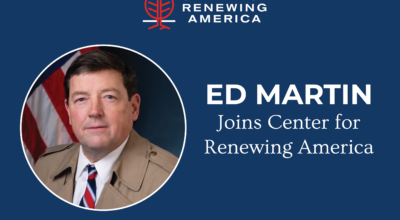
Former Trump DOJ Official Ed Martin Joins Center for Renewing America As Distinguished Fellow
Today the Center for Renewing America (CRA), founded by White House Office of Management and Budget Director Russ Vought, announced that Edward R. Martin Jr., a veteran public servant and former senior official in the Trump Administration’s Department of Justice, will join the organization as a Distinguished Fellow.