

America at 300
We have fifty years to make things better, so that on America’s 300th, we truly do have a nation dedicated to that vision. On July 5th, 2026, that clock starts ticking.
Had Donald Trump not won in 2024, the celebration of the 250th anniversary of the United States would have been a catastrophe. Although most Americans did not realize it, the Left was setting the terms for the celebration of American independence.
In 2016, Barack Obama launched the United States Semiquincentennial Commission to prepare the country to celebrate its 250th birthday. Since this followed the path Richard Nixon had taken to launch the American Revolution Bicentennial Administration in 1973, it resembled past bipartisan practice, promoting, as the 1973 commission put it, “the development of our national heritage of individual liberty, representative government, and the attainment of equal and inalienable rights” in the forthcoming national celebration.
In fact, the stakeholders involved in advising the Semiquincentennial Commission–foundations, Museums, public trusts, nonprofits, and Facebook—had little interest in promoting that vision of the Founding. By involving such fortresses of leftist orthodoxy in planning, the Semiquincentennial Commission made it clear it was more interested in promoting diversity than in celebrating a cogent account of the Founding’s success. In 2021, the Commission was using the slogan, “Get ready for the biggest, most inclusive commemoration in our nation’s history” (it’s since been revised). By 2022, the Commission was mired in its own scandal of inclusion, with senior staff resigning because the Commission was run by men.
Older Americans are likely to remember the 1976 celebrations for the big, centrally organized shows, such as the 200-vessel flotilla of Operation Sail that sailed around New York City. That’s not the way the 2016 Commission imagined the bicentennial. It embraced a reimagined version of 1976 as a grassroots struggle for inclusion against top-down organization. In this story, groups such as the People’s Bicentennial Commission saw President Nixon’s planning committee as “seeking to use the commemoration for his own political purposes.” The People’s Bicentennial Commission urged Americans to avoid the official centralized planning and “find their own ways to celebrate, whether that meant researching local history, planning community events, or using the American Revolution as inspiration for contemporary social movements.” But this appeal to grassroots organization was really a template to organize a series of protests to try and commemorate the Founding as a lodestar for radical politics. One event organized by the People’s Bicentennial Commission saw the burning of an effigy of President Gerald Ford.
The organizers of the Bicentennial were wise to these tricks. In March 1976, a Congressional subcommittee investigated and exposed the leftist agitation of the People’s Bicentennial Commission. It represented “a propaganda and organizing tool of a small group of new-left political extremists…who seek to pervert the meaning of the American Revolution.” And when Leftists agitated against the inclusion of the Chilean barque the Esmeralda in the flotilla of Operation Sail, because of the allegations it had been used to detain and torture political prisoners under Augusto Pinochet’s recent coup, the flotilla’s organizers refused. Frank Braynard, the historian overseeing the project, observed of the Esmeralda that “she’s one of the finest sailing ships in the world, and one of the most desired to have in any port.” Braynard saw the power of honoring beauty and excellence in civic liturgies as more important than virtue-signalling. “We’re trying to do something positive, not dwell on past horrors,” he said. Leftist promised mass protests, but they never materialized. The flotilla ended up drawing six million New Yorkers out, the largest crowd in the city’s history.
Nevertheless, the revisionist reading of 1976 as a grassroots-driven protest against administrative and ideological centralization influenced the 2016 committee. Following the committee’s official launch, preparation for 2026 focused on “intentionally planning a commemoration of U.S. history driven by local interests.” That made it easier to adjust and alter the meaning of the whole event by introducing multiple meanings to obscure the core teachings of 1776 that the 1973 commission had tried to transmit. The Smithsonian Institution promoted the idea of “the many 1776s,” an exhibition to be held across the National Museum of African American History and Culture, the National Museum of the American Indian and the Smithsonian Latino Center. And the encouragement for local authorities to create their own commissions followed a similar script, even in Republican majority states. The Nebraska 250th commission promised to “promote under-represented groups from the American Revolutionary War, including, but not limited to, women, American Indians, and persons of color.” South Carolina’s 250th commission plans to share history “from all points of view,” including “the beauty and the warts and the terror of it all.”
Such descriptions—“under-represented,” “warts,” “terror”–evinced the real purpose of 2026 planning prior to President Trump. Under the guise of promoting the “most inclusive commemoration in our nation’s history,” organizers introduced narratives that showcased the Founding’s failures to be sufficiently inclusive. These were strategies to delegitimize the Founding itself, casting a shadow over the nation’s birthday or interpreting it as an exhortation to do more. And there was another side to this strategy. By promoting local events at a distance from the main government and its institutions, organizers could also use the celebration of the revolution to delegitimize those in power. In short, when it came to the planning for 2026, it was the New Left of the 1970s that was setting the celebration’s terms. And unlike in the 1970s, the institutions that were supposed to resist those strategies of delegitimization were embracing them.
President Trump’s second term provided the opportunity to change course. Trump immediately did. In January 2025, the White House launched a new task force, “Freedom250,” tasked with running the official events for the Semiquincentennial. While this has provoked the expected protests from minor celebrities and performers slated to give concerts under prior planning, Freedom250 has reset the celebrations to align more with the real achievements of 1976—big, splashy performances that attract large audiences regardless of their political preferences.
Nevertheless, we need to take stock of the situation 2026 reveals. The issues run deeper than splits over national pride and declining patriotism; while national pride holds strong amongst Republicans, it has collapsed among Democrats and is even declining amongst independents. Similar fissures appeared in 1970s America. The Vietnam War, campus protests, urban unrest, inflation, Watergate, and rising crime in American cities were all seminal events for a collapse of civic trust. The pieces of postwar confidence and unity had fallen apart. But the 1976 celebrations provided a flashpoint for the expression of civic ties that ran deeper than all those points of fracture. It was possible because the governing institutions were still sound. In 2026, by contrast, from national museums downwards, the institutions tasked with commemorating and transmitting the nation’s heritage can no longer be trusted. In this environment, more traditional civic liturgy will attract strenuous protests and see organized boycotts from activists and blue states.
There is a clear but challenging path forward. The Left accuses the Trump administration of politicizing the celebrations, but that framing should be embraced. The celebrations provide an opportunity to showcase the importance of what kind of political regime Americans chose to adopt 250 years ago and to transmit the creed and culture that underwrites that regime. It provides an opportunity to set the terms for what citizenship means; to draw boundaries rather than make calls for “inclusion” that invent new friend-enemy divides between those who are deemed to exclude. Calls to “de-politicize” civic celebrations water down the content to sentimentalism that may be uncontroversial but does little to communicate anything serious. And calls to “de-politicize” really serve to hand power over what kind of civic celebrations we should have and what they express to institutions that work to multiply the meanings of 1776. De-politicization is a strategy of capitulation. It allows institutions defined by the priorities of the Left to set the terms.
Embracing the politics of 1776 provides a place to stand to chart a different future from that of the last fifty years. From 1976 onwards, decades of pollyannish confidence and naïve optimism in the American experiment distracted us from the Left’s march through the institutions. A true national renewal is only possible once we have stripped the Left of their power and built new institutions that can be trusted to reflect and transmit the Founding’s vision of government, natural rights, and natural law. We have fifty years to make things better, so that on America’s 300th, we truly do have a nation dedicated to that vision. On July 5th, 2026, that clock starts ticking.
Referenced Documents

Related Posts
Can Congress Seat a Member-Elect Who Vows to Destroy our Constitution?
The November 2026 election could produce a member-elect of the House of Representatives who belongs to an organization and adheres to an ideology that has expressly advocated destroying significant components of the existing constitutional structure and who has personally acted to seek those ends.

CRA Submits Comment Supporting Census Bureau’s Proposed Rule
The proposed rule is an important step toward de-weaponizing the decennial
Census. For too long, the Census has been treated as an all-purpose statistical
product rather than as a distinct constitutional function that determines the
allocation of political representation in the United States.
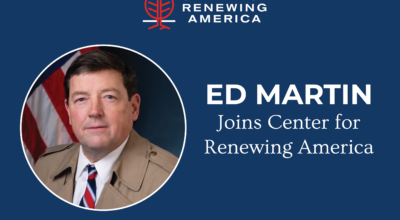
Former Trump DOJ Official Ed Martin Joins Center for Renewing America As Distinguished Fellow
Today the Center for Renewing America (CRA), founded by White House Office of Management and Budget Director Russ Vought, announced that Edward R. Martin Jr., a veteran public servant and former senior official in the Trump Administration’s Department of Justice, will join the organization as a Distinguished Fellow.