
The Article I Path to Ending Birthright-Citizenship Abuse
Congress should go on offense and respond immediately by amending 8 U.S.C. § 1401(a) to codify what the Fourteenth Amendment already requires: citizenship at birth belongs only to persons born in the United States while subject to the nation’s complete political jurisdiction.
The question in Trump v. Barbara is whether the president may direct the executive branch to apply the citizenship clause and 8 U.S.C. § 1401(a) according to their original meaning. If the Supreme Court holds that the executive may not do so unilaterally, that ruling would not exhaust the Constitution’s remedies. It would merely shift the fight to the branch that wrote the Immigration and Nationality Act in the first place: Congress.
Congress should go on offense and respond immediately by amending 8 U.S.C. § 1401(a) to codify what the Fourteenth Amendment already requires: citizenship at birth belongs only to persons born in the United States while subject to the nation’s complete political jurisdiction.1 The Constitution does not define jurisdiction, and Congress has the core constitutional power to legislate on this issue to define complete political jurisdiction.2 That standard, of which the Center for Renewing America has been at the forefront,3 excludes the children of aliens who are unlawfully present, as well as the children of tourists, students, exchange visitors, temporary workers, and other nonimmigrants whose presence is temporary and whose political allegiance remains with another sovereign. The standard we set forth for complete and total jurisdiction does not exclude birthright citizenship claims of children born in the country to lawful permanent residents.
The statute should be passed by simple majority. If the Senate filibuster stands in the way, the majority should invoke the constitutional or nuclear option and establish a precedent for majority cloture on this legislation. The Senate’s rules cannot be permitted to entrench a supermajority veto over Congress’s duty to define the nation’s membership.4 The current legislative filibuster ordinarily requires three-fifths cloture, or 60 senators, while the Senate has used majority power before to lower cloture thresholds for nominations.
This would provoke immediate litigation, and that is the point. If the Court avoids the merits or rules only that the executive lacks unilateral authority, Congress must force the constitutional question in its cleanest form: whether the elected legislature may define “subject to the jurisdiction” in the INA consistently with the Citizenship Clause’s original meaning.5 If the judiciary then strikes that statute down, the country will have clarity: the only remaining remedy is an Article V amendment.6
The Constitution does not confer citizenship by soil alone.7 The Citizenship Clause grants citizenship only to persons “born or naturalized in the United States, and subject to the jurisdiction thereof,” which means birth in the United States is necessary but not sufficient.8 The phrase “subject to the jurisdiction thereof” must do real work, and the Supreme Court has held that it requires not subjection “in some respect or degree,” but complete subjection to the United States and “direct and immediate allegiance” to it.9 The Center’s core position is correct: the Clause turns on complete political jurisdiction, meaning lawful allegiance, reciprocal protection, and membership in the national political community, not mere physical presence inside American territory.10
Territorial jurisdiction is not political jurisdiction, because aliens may be subject to American criminal, civil, and constitutional law while physically present without becoming members of the sovereign people.11 Tourists, students, exchange visitors, and temporary workers enter under limited statutory permission, not as members of the American political community, and their temporary presence does not create complete political allegiance to the United States.12 Illegal aliens stand even farther outside complete political jurisdiction because they are present contrary to the sovereign’s lawful terms of admission and are subject to removal.13
Opponents will invoke United States v. Wong Kim Ark, but that case involved a child born to parents who were domiciled resident aliens carrying on business in the United States, not children of tourists, students, guest workers, or illegal aliens.14 Wong Kim Ark did not adopt a blanket jus soli rule; it grounded birthright citizenship in the common-law relationship of allegiance and protection.15 That common-law rule came from Calvin’s Case, which rejected soil alone and held that “[allegiance] is a quality of the mind, and not confined within any place,” and that “it is not the soil, but [allegiance] and [obedience] that make the subject born.”16 The early Fourteenth Amendment cases confirm the same rule; The Slaughter-House Cases described the Citizenship Clause as excluding children of foreign ministers, consuls, and “citizens or subjects of foreign States born within the United States.”17
Congress therefore has a clear Article I path: Congress wrote 8 U.S.C. § 1401(a), Congress may amend 8 U.S.C. § 1401(a), and Congress may define by statute that “subject to the jurisdiction” means subject to the complete political jurisdiction of the United States at birth.18 That Article I power is independent of any executive order, because if the Court holds only that the president cannot act alone under existing law, Congress can change existing law through bicameralism and presentment.19
This statute would not repeal the Fourteenth Amendment by ordinary legislation; it would enforce the Amendment’s own jurisdictional requirement and force the Court to decide the clean Article I question, with Congress having the constitutional power to enforce the amendment by the necessary enacting legislation.20
Conclusion
If the Supreme Court ends birthright-citizenship abuse outright, Congress should conform the INA to that holding. If the Court rules only that the executive branch cannot act alone, Congress should act the next day on its own. If the Court grants a carve-out and holds that Congress can define jurisdiction, then the legislature should add the political-jurisdiction standard of citizenship to the SAVE Act. If the Senate filibuster blocks the bill, the majority should invoke the constitutional or nuclear option and establish simple-majority cloture for this legislation, because the Senate’s rules are not the Constitution and each house has power to determine its own rules.21
Citizenship is not an accident of geography. It is membership in a political community. Tourists, students, guest workers, parolees, and unlawfully present aliens may be subject to the territorial laws of the United States while they are here. But they remain outside the nation’s complete political jurisdiction. Their children are therefore outside the Citizenship Clause’s jurisdictional predicate unless Congress or the Constitution provides otherwise.
The Article I response is not optional. Congress wrote the INA. Congress can amend it. Congress can codify complete political jurisdiction, force judicial review, and, if necessary, tee up the constitutional amendment fight the country can no longer avoid.
Endnotes
1. See 8 U.S.C. § 1401(a); see also U.S. CONST amend. XIV, § 1, cl. 1.
2. U.S. CONST art. 1, § 1.
3. Ken Cuccinelli & Benjamin Osborne, CRA Files an Amicus Brief to the Supreme Court of the United States supporting President Trump’s Argument to End Birthright Citizenship for the Children of Illegal Immigrants, CNTR. FOR RENEWING AM. (Jan. 23, 2026), https://americarenewing.com/cra-files-an-amicus-brief-to-the-supreme-court-of-the-united-states-supporting-president-trumps-argument-to-end-birthright-citizenship-for-the-children-of-illegal-immigrants/; Ken Cuccinelli, Primer: Ending Birthright Citizenship Is Imperative for Preserving the United States, CNTR. FOR RENEWING AM. (Feb. 11, 2025), https://americarenewing.com/issues/primer-ending-birthright-citizenship-is-imperative-for-preserving-the-united-states/.
4. Wade Miller, Primer: America First, Not Senate First, CNTR. FOR RENEWING AM. (June 18, 2025), https://americarenewing.com/issues/primer-america-first-not-senate-first/ (showing that the Senate must no longer be Senate First but America First and can no longer give in to entrenched ideas of preserving the filibuster, which prevents the will of the people from being enacted by its elected representatives).
5. 8 U.S.C. § 1401(a); U.S. CONST amend. XIV, § 1, cl. 1.
6. U.S. CONST art. V.
7. U.S. CONST amend. XIV, § 1, cl. 1.
8. Id.
9. Elk v. Wilkins, 112 U.S. 94, 101–02 (1884).
10. Id.; Cong. Globe, 39th Cong., 1st Sess. 2893 (1866) (statement of Sen. Trumbull).
11. Yick Wo v. Hopkins, 118 U.S. 356, 369 (1886); Wong Wing v. United States, 163 U.S. 228, 238 (1896); Plyler v. Doe, 457 U.S. 202, 210 (1982); Elk, 112 U.S. at 101–02.
12. 8 U.S.C. § 1101(a)(15)(B), (F), (J), (H); Elk, 112 U.S. at 101–02.
13. 8 U.S.C. §§ 1182(a)(6)(A)(i), 1227(a)(1).
14. United States v. Wong Kim Ark, 169 U.S. 649, 652, 693 (1898).
15. Id. at 654–55, 693.
16. Calvin’s Case, 77 Eng. Rep. 377, 382, 384 (1608).
17. The Slaughter-House Cases, 83 U.S. 36, 73 (1873).
18. U.S. CONST. art. I, § 8, cls. 4, 18; Id. amend. XIV, § 5; 8 U.S.C. § 1401(a).
19. U.S. CONST. art. I, § 7; INS v. Chadha, 462 U.S. 919, 946–51 (1983).
20. U.S. CONST. amend. XIV, §§ 1, 5; City of Boerne v. Flores, 521 U.S. 507, 519–20 (1997).
21. U.S. CONST. art. I, § 5, cl. 2; United States v. Ballin, 144 U.S. 1, 5 (1892).
Referenced Documents
Related Posts
Can Congress Seat a Member-Elect Who Vows to Destroy our Constitution?
The November 2026 election could produce a member-elect of the House of Representatives who belongs to an organization and adheres to an ideology that has expressly advocated destroying significant components of the existing constitutional structure and who has personally acted to seek those ends.

CRA Submits Comment Supporting Census Bureau’s Proposed Rule
The proposed rule is an important step toward de-weaponizing the decennial
Census. For too long, the Census has been treated as an all-purpose statistical
product rather than as a distinct constitutional function that determines the
allocation of political representation in the United States.
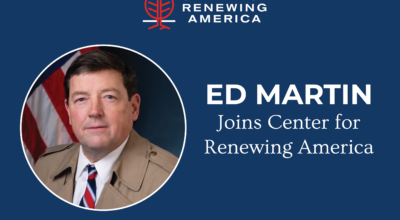
Former Trump DOJ Official Ed Martin Joins Center for Renewing America As Distinguished Fellow
Today the Center for Renewing America (CRA), founded by White House Office of Management and Budget Director Russ Vought, announced that Edward R. Martin Jr., a veteran public servant and former senior official in the Trump Administration’s Department of Justice, will join the organization as a Distinguished Fellow.