

Primer: Age-Verification for Children’s Online Safety
To protect American children, the federal government should adopt an age-verification scheme for adult websites, and states should enact age-verification requirements for social media.
Introduction
In the digital age, vice is more accessible than ever. Smartphones have made pornography free, portable, and instantly available. Unsupervised internet use is widespread, and this development is particularly dangerous for America’s youth. The failure to restrict access to obscene adult content has left minors unprotected, opening the door to addiction and sexual depravity. Recognizing this crisis, many states have instituted age-verification requirements for adult websites and social media platforms. Although the Supreme Court upheld Texas’s age-verification system in Free Speech Coalition, Inc. v. Paxton, state legislation continues to face legal challenges. Even so, the long-term effects of these measures are promising. To protect American children, the federal government should adopt an age-verification scheme for adult websites, and states should enact age-verification requirements for social media.
The Growing Risk of Pornography Exposure
Before the rise of the internet, numerous guardrails existed to protect minors from exposure to inappropriate content in the United States. To obtain explicit material, a person had to travel to a physical store, show a photo ID, and pay money to purchase it. The same went for strip clubs and adult movie theaters: Customers were required to prove they were 18 years old before admittance. The FCC prohibited radio and TV providers from broadcasting obscenity and imposed heavy restrictions on indecent material during hours when children were likely to watch. Much of this structure remains in place today, but it has not been updated to reflect the needs of the twenty-first century. Pornography consumption has shifted almost entirely from physical media to internet distribution. Ninety-two percent of adult websites have adopted Pornhub’s ad revenue–based model, making explicit content effectively free.1 We are left with an absurdly outdated system. A 15-year-old cannot watch Christopher Nolan’s film The Odyssey in a theater without a parent, but he is allowed to access as much internet pornography as he pleases.
For the vast majority of American children, internet use dominates daily life. Smartphones are nearly universal, with 95% of teenagers owning a device.2 Social media use is similarly ubiquitous, with 92% of teens watching YouTube, 68% scrolling TikTok, 63% posting on Instagram, and 55% communicating through Snapchat.3 In total, teenagers average 8 hours and 39 minutes of digital media use per day.4 School provides no respite from this barrage of internet exposure. The Department of Education reports that 94% of K–12 public schools provide students with digital devices such as laptops and tablets.5
With the majority of their waking hours spent online, it is unsurprising that children are exposed to obscene content at a younger age than ever before. A study by Common Sense Media in 2023 found that the average American child is first exposed to pornography at the age of 12.6 Fifteen percent of respondents reported watching pornography at age 10 or younger. In an average fourth-grade classroom of 20 students, three have already witnessed obscene material. This content is increasingly violent and extreme. Fifty-two percent of children exposed to pornography reported having seen depictions of rape, choking, or someone in pain.7 Among children who watch pornography three or more times per week, the number rises to 80%.8
The Harm to Children
The damage is evident. Studies have shown childhood pornography exposure to be associated with increased anxiety, depression, and reduced well-being.9 Obscene content distorts traditional morality surrounding sex and family. More frequent use of sexually explicit internet material has been shown to foster greater uncertainty in adolescents’ formation of sexual values.10 Yet the harm done by pornography is not merely internal. A John Hopkins University study found that boys and girls who consume X-rated material are five times more likely to exhibit sexually aggressive behavior.11 When children see depictions of sexual violence, polygamy, and incest on a weekly basis, they become more likely to exhibit such behaviors themselves.
Pornography exposure not only harms children’s sexual development but stunts overall maturation. As they grow, children must learn to delay immediate gratification to accomplish long-term goals. When this skill is lost, individuals become unable to contribute to society. Many drug addicts, for example, cannot subordinate their immediate desire to get high to their long-term desire to pay rent, and subsequently they end up homeless. Research has shown that this phenomenon, known as “delay discounting,” is associated with pornography use.12 When children are given access to endless short-term pleasure in the form of adult videos, they do not develop the discipline needed to delay gratification, get married, and form a family. It is no surprise that the country with the highest rate of problematic pornography use, Taiwan, has the lowest birth rate in the world.13
From Ashcroft to Paxton
In 1998, Congress passed the Child Online Protection Act (COPA). COPA amended the Communications Act of 1934 to make it unlawful to commercially distribute content harmful to minors on the internet. Pornography websites that failed to block children from viewing harmful content could be criminally charged. However, websites could shield themselves from prosecution by verifying the age of customers through their credit or debit card number.
The ACLU filed suit following the passage of COPA, claiming that the act violated the First Amendment protection for freedom of speech. A district court issued a preliminary injunction preventing the statute from taking effect. After six years of litigation, the Supreme Court took up the case in Ashcroft v. American Civil Liberties Union (2004). In a narrow 5–4 decision, the Court held that laws restricting internet pornography must pass strict scrutiny. This means that in order to not be struck down, the government must prove first that there is a compelling interest in limiting the content and second that the law provides the least restrictive means for accomplishing this interest. The Court determined that internet filters were a less restrictive way to prevent pornography access by minors than an age-verification system. Therefore, COPA did not meet strict scrutiny and was struck down as unconstitutional.
In 2023, the Center for Renewing America (CRA) called for the Supreme Court to reevaluate its holding in Ashcroft.14 CRA observed that the factual precedents of Ashcroft had been invalidated in the two decades since the Court struck down COPA. The statute was ruled unconstitutional on the basis that filters are more effective than age-verification requirements, so age verification is overly broad and burdensome. However, parent-implemented filters have proven utterly ineffective at stopping underage pornography exposure. Furthermore, the introduction of the smartphone has exacerbated the crisis, and therefore more extensive measures are necessary. The factual assumptions about technology on which the Court’s ruling stood no longer hold true. CRA provided a list of secure age-verification techniques for states to challenge and circumvent Ashcroft.
Louisiana was the first state to pursue this course of action, requiring websites that contain a “substantial portion” (33.3%) of adult content to implement age verification. By 2024, many states had enacted similar legislation. The pornography trade association Free Speech Coalition filed suit, arguing that a Texas age-verification law was unconstitutional under Ashcroft. In Free Speech Coalition v. Paxton (2025), the Supreme Court effectively overruled its holding in Ashcroft. The Court held that laws limiting access to pornography are subject not to strict scrutiny review but only to the weaker intermediate scrutiny. Writing for the majority, Justice Clarence Thomas explained that Texas’s age-verification law did not violate the First Amendment because the statute was narrowly tailored to the state’s substantial interest in preventing harm to minors.
The Current Landscape of Age-Verification Laws
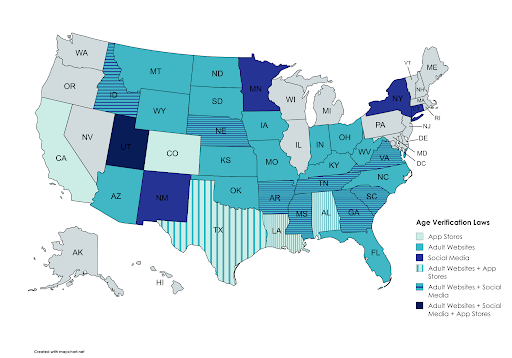
In the wake of Paxton, 27 states have passed laws requiring age verification for adult websites. CRA has acknowledged that age-verification mandates for adult websites alone are insufficient to protect children from pornography exposure.15 This is demonstrated by the failure of the UK’s Online Safety Act. After the UK instituted age verification for adult websites, youth pornography viewership rose.16 Although children were barred from accessing websites such as Pornhub and Xvideos, access to social media remained unchanged. Platforms such as X and Reddit explicitly allow users to upload hardcore explicit videos, and TikTok, Instagram, and YouTube are filled with soft-core pornography.17 When the Online Safety Act went into effect, children simply migrated to new platforms. Today, social media sites account for 80% of the sources by which British children access pornography.18 This percentage sits at 38% in the United States and will likely only rise as adult websites become more difficult for youth to access.19
Understanding this dynamic, CRA issued a policy proposal in 2023 recommending that states prohibit the creation of social media accounts for users under age 18 without express parental consent.20 As of July 2026, 12 states have adopted this policy. Notably, this includes three blue states: Minnesota, New Mexico, and New York. In addition to adult websites and social media platforms, six states have enacted laws requiring app stores to verify users’ age and prevent minors from downloading non-age-appropriate apps.
The Road Ahead
Significant progress has been made in the last five years to protect children from harmful internet content. But more work remains to be done. Children in 23 states can still freely access adult websites. Minors can create social media accounts without parental approval in 38 states, allowing them to obtain explicit content even in states with restrictions on pornographic websites. Additionally, even in states with strong protections, minors can circumvent age-verification systems by using a parent’s or adult friend’s ID card. A more robust system must be put into place.
First, Congress should pass an updated version of the 1998 Child Online Protection Act. By implementing a nationwide age-verification model, Congress could ensure that children in all 50 states are protected from adult websites. This legislation should follow the framework upheld by the Supreme Court in Paxton to minimize legal challenges.
Second, state legislators should lead a bipartisan push for age verification on social media and app stores. Democrat-majority states such as New York, California, and Minnesota have implemented such systems in one form or another. Given the significant harm to children caused by social media in the past decade, these measures have the potential to garner support across the aisle.
Third, conservative-leaning states should not be content to settle for the policy upheld in Paxton. Notable efforts at responding more seriously to this crisis include:
- Tennessee’s Protect Tennessee Minors Act, which requires adult websites to reverify the age of users every 60 minutes, making it more difficult for kids to circumvent verification21
- Texas’s Penal Code § 21.165, which requires websites that offer tools for making deepfake pornography to provide age verification22
- Utah’s Children’s Device Protection Act, which requires all smartphone and tablet devices in the state to be equipped with a filter to block obscene content that must be automatically enabled for users under age 1823
- Virginia’s Social Media Safety Act, which limits social media screen time to one hour per day for users under 1624
New age-verification laws will likely be met with litigation by Big Tech and adult video industry groups. State legislators must be prepared to amend and adapt statutes in the event that certain provisions are found to be unconstitutional.
Conclusion
Pornography causes irreparable damage to the minds of young children. For decades, U.S. law has failed to adequately protect minors from the dangers of the internet. We require ID checks to ensure that children cannot obtain alcohol or tobacco or watch R-rated movies, but we allow open access to social media and adult websites. Recent state-level efforts are a step in the right direction, but they are inadequate in their current form. To protect the next generation of youth, Congress should pass a nationwide age-verification mandate for adult websites, and states should work to develop constitutional age-verification schemes for social media.
Endnotes
1. Wondracek, G. et al. (June 2010). “Is the Internet for Porn? An Insight into the Online Adult Industry,” Workshop on the Economics of Information Security. https://www.researchgate.net/publication/242581158_Is_the_Internet_for
2. Faverio, M. and Sidoti, O. (2024). “Teens, Social Media and Technology 2024,” Pew Research Center. https://www.pewresearch.org/internet/2024/12/12/teens-social-media-and-technology-2024/
3. Faverio, M. and Sidoti, O. (2025). “Teens, Social Media and AI Chatbots 2025,” Pew Research Center. https://www.pewresearch.org/internet/2025/12/09/teens-social-media-and-ai-chatbots-2025/
4. Rideout, V. et al. (2022). “Common Sense Census: Media Use by Tweens and Teens, 2021,” Common Sense Media. https://www.commonsensemedia.org/research/the-common-sense-census-media-use-by-tweens-and-teens
5. Kuykendall, K. (September 27, 2022). “New Data: Nearly Half of Schools Providing Home Internet Access to Students Who Need It This School Year,” Technological Horizons in Education Journal. https://thejournal.com/articles/2022/09/27/nearly-half-of-schools-providing-home-internet-access-to-students-who-need-it-this-school-year.aspx
6. Robb, M.B., and Mann, S. (2023). “Teens and Pornography,” Common Sense Media. https://www.commonsensemedia.org/sites/default/files/research/report/2022-teens-and-pornography-final-web.pdf
7. Ibid.
8. Ibid.
9. Kohut, T. and Štulhofer, A. (August 10, 2018). “Is Pornography Use a Risk for Adolescent Well-Being? An Examination of Temporal Relationships in Two Independent Panel Samples,” PLOS One. https://journals.plos.org/plosone/article?id=10.1371/journal.pone.0202048
10. Peter, J. and Valkenburg, P.M. (2008). “Adolescents’ Exposure to Sexually Explicit Internet Material, Sexual Uncertainty, and Attitudes Toward Uncommitted Sexual Exploration: Is There a Link?,” Communication Research.
11. Ybarra, M.L. et al. (2011). “X-rated Material and Perpetration of Sexually Aggressive Behavior Among Children and Adolescents: Is There a Link?,” Aggressive Behavior. https://doi.org/10.1002/ab.20367
12. Negash, S. et al. (August 25, 2015). “Trading Later Rewards for Current Pleasure: Pornography Consumption and Delay Discounting,” The Journal of Sex Research. https://doi.org/10.1080/00224499.2015.1025123
13. Bothe, B. et al. (2023). “Problematic Pornography Use Across Countries, Genders, and Sexual Orientations: Insights from the International Sex Survey and Comparison of Different Assessment Tools,” Addiction. https://doi.org/10.1111/add.16431; McCartney, M. (January 12, 2026). “World Has New Lowest Birth Rate,” Newsweek. https://www.newsweek.com/world-has-new-lowest-birth-rate-11343356
14. Candeub, A. (July 21, 2023). “Online Age-Verification: Protecting Children and Privacy,” Center for Renewing America. https://americarenewing.com/issues/identity-on-the-internet-protecting-children-and-privacy
15. Candeub, A., Morell, C. and Parsons, H. (January 24, 2023). “Four Legislative Proposals for States to Protect Children from Online Obscenity,” Center for Renewing America. https://citizensrenewingamerica.com/issues/four-legislative-proposals-for-states-to-protect-children-from-online-obscenity/
16. Syal, R. (August 18, 2025). “Children’s Exposure to Porn Higher Than Before 2023 Online Safety Act, Poll Finds,” The Guardian. https://www.theguardian.com/society/2025/aug/18/children-exposure-to-porn-
17. Siddiqui, F. (February 2, 2026). “Why Elon Musk’s X Is Embracing Adult Content,” The Washington Post. https://www.washingtonpost.com/politics/2024/06/05/elon-musk-x-porn-adult-content/; Petrovic, S. and Savic, M. (November 19, 2023). “TikTok Has a Startling Amount of Sexual Content—and It’s Way Too Easy for Children to Access,” The Conversation. https://theconversation.com/tiktok-has-a-startling-amount-of-sexual-content-and-its-way-too-easy-for-children-to-access-216114
18. Syal, R. (August 18, 2025). “Children’s Exposure to Porn Higher Than Before 2023 Online Safety Act, Poll Finds,” The Guardian. https://www.theguardian.com/society/2025/aug/18/children-exposure-to-porn-
19. Robb, M.B., and Mann, S. (2023). “Teens and Pornography,” Common Sense Media. https://www.commonsensemedia.org/sites/default/files/research/report/2022-teens-and-pornography-final-web.pdf
20. Candeub, A., Morell, C. and Parsons, H. (January 24, 2023). “Four Legislative Proposals for States to Protect Children from Online Obscenity,” Center for Renewing America. https://citizensrenewingamerica.com/issues/four-legislative-proposals-for-states-to-protect-children-from-online-obscenity/
21. Thomson Reuters Staff (May 3, 2024). “Tennessee Enacts Social Media Age Verification and Parental Consent Law,” Thomson Reuters Practical Law. https://anzlaw.thomsonreuters.com/w-043-2130
22. Jenkins, A. (December 2, 2024). “Texas Bill Requires Age Restrictions on Explicit AI Sites,” Pluribus News. https://pluribusnews.com/news-and-events/texas-bill-requires-age-restrictions-on-explicit-ai-sites/
23. Dunphey, K. (January 24, 2024). “Utah Could Mandate New Restrictions on Smartphones for Minors, but Tech Groups Have Concerns,” Utah News Dispatch. https://utahnewsdispatch.com/2024/01/24/utah-smartphone-
24. Roever, A. (February 16, 2026). “Virginia to Enforce Law Limiting Minors’ Social Media Use to One Hour Daily,” ABC News WRIC. https://www.wric.com/news/virginia-news/law-limiting-minors-social-media-1-
Referenced Documents

Related Posts
Can Congress Seat a Member-Elect Who Vows to Destroy our Constitution?
The November 2026 election could produce a member-elect of the House of Representatives who belongs to an organization and adheres to an ideology that has expressly advocated destroying significant components of the existing constitutional structure and who has personally acted to seek those ends.
CRA Submits Comment Supporting Census Bureau’s Proposed Rule
The proposed rule is an important step toward de-weaponizing the decennial
Census. For too long, the Census has been treated as an all-purpose statistical
product rather than as a distinct constitutional function that determines the
allocation of political representation in the United States.
Former Trump DOJ Official Ed Martin Joins Center for Renewing America As Distinguished Fellow
Today the Center for Renewing America (CRA), founded by White House Office of Management and Budget Director Russ Vought, announced that Edward R. Martin Jr., a veteran public servant and former senior official in the Trump Administration’s Department of Justice, will join the organization as a Distinguished Fellow.