


Primer: Family Formation and Child-Care Policies
Family and Future Series
Summary
For the past several decades, public policy in the United States has viewed the “child-care affordability problem” through a narrow lens: the cost of institutional, center-based care. Yet the real challenge for many American families, especially married parents with young children, is economic insecurity that makes it impossible for one parent to stay home and care for their own children. Even with both parents working full time and earning a combined median wage of about $81,000 annually1, the ends often do not meet. However, the prevailing dual-income norm does not reflect the actual preferences of most parents and undermines the inherent dignity of raising children, especially for mothers.
This paper argues that the ability to care for one’s own children is a social good of the highest order, and that the federal government and state policies should restore conditions under which this ideal is attainable for a majority of families. There are those who will choose otherwise, and this is not an attempt to prescribe a single model of family life, but rather to ensure that parents are no longer forced by economic necessity into arrangements they would not freely choose. Therefore, the goal is to restore genuine choice rather than restrict it.
The primary proposals outlined below are a strengthened and expanded Child Tax Credit, a marriage bonus, and reformed subsidy structures that respect parental choice. Other reforms to foster informal care networks and reduce the cost of formal, center-based care through regulatory revision are also explored. Finally, emphasis is placed on a public policy that affirms, rather than denigrates, the value of stay-at-home parenting, specifically for mothers. Taken together, these policies re-center children and families in the national conversation about the affordability of family formation in America.
Parental Care as the Highest Social Value
Throughout American history, the ideal has consistently been that children are best raised by their own parents within lifelong marriage when possible. This ideal was expressed in the politics of the early twentieth century and in women’s advocacy movements, which sought not to push women into paid labor but to ensure that women had the economic security and respect to care for their children.
Allan Carlson documents in The American Way: Family and Community in the Shaping of the American Identity how President Theodore Roosevelt articulated one of the most explicit and comprehensive family-centered visions ever advanced by an American statesman.2 For Roosevelt, the family was not a private lifestyle preference but the foundational institution of the republic. It preceded the market and was indispensable to the nation’s survival: “The woman’s task is not easy—no task worth doing is easy—but in doing it, and when she has done it, there shall come to her the highest and holiest joy known to mankind; and, having done it, she shall have the reward prophesied in Scripture; for her husband and her children, yes, and all people who realize that her work lies at the foundation of all National happiness and greatness, shall rise up and call her blessed.”3 This was the animating principle of a coherent family policy that understood economic arrangements as either sustaining or undermining the home.
Roosevelt identified uncontrolled industrialism as a principal enemy of family life. He believed that industrial logic, treating parents as interchangeable labor units and children as obstacles to productivity, would result in the destruction of the family, the ruin of motherhood, and the degradation of childhood, and he called for an end to child labor and a reduction in women’s labor.4 The home, in Roosevelt’s view, had to be actively protected from the market if it were to remain a place of formation rather than exhaustion. This insight bears directly on today’s child-care debate: When public policy assumes that both parents must be fully absorbed into the labor market, it tacitly concedes the industrialization of family life rather than resisting it.
Roosevelt also rejected the intellectual currents that justified this erosion of the family. He sharply criticized the influence of Malthusian population theory, the radical individualism of John Stuart Mill, and what he described as the false moralism of “sham reformers” who elevated comfort, autonomy, or efficiency above duty and continuity. In a 1902 letter, Roosevelt condemned the “mere vapid pleasure”–seeking that encouraged educated elites to avoid marriage and children, warning that “the man or woman who deliberately avoids marriage, and has a heart so cold as to know no passion and a brain so shallow and selfish as to dislike having children, is in effect a criminal against the race, and should be an object of contemptuous abhorrence by all healthy people.”5
On feminism, Roosevelt’s position was both nuanced and firm. He was an early supporter of women’s legal protections and political participation, writing sympathetically about women’s rights and endorsing what would later be called maternalist feminism, which is the idea that society had an obligation to protect motherhood and recognize women’s distinctive contributions to civic life. At the same time, he was an unsparing critic of what he called “professional feminists,” who derided wives and mothers as “parasite women.”6 Roosevelt rejected this ideology outright, insisting that motherhood was not a mark of dependency but of honor: “No man, not even the soldier who does his duty, stands quite on the level with the wife and mother who has done her duty.”7 Any feminism that denied this truth, he argued, was not emancipatory but destructive.
Roosevelt also warned against science severed from moral principle, particularly the emerging eugenics movement, which sought to regulate reproduction through technocratic control rather than moral responsibility. Such thinking, he believed, treated human beings as livestock and substituted social engineering for the natural obligations of family life. For Roosevelt, the answer to demographic decline was not coercion but policy that made family formation economically viable and socially honored.
Accordingly, Roosevelt advanced a comprehensive family policy aimed at restoring the conditions under which ordinary Americans could marry, raise children, and sustain a household on a single wage. He supported differential taxation that favored families with children over the childless, including child exemptions that increased with each additional child. He endorsed a German-style health insurance system designed explicitly to protect motherhood and childhood from economic insecurity. He argued that women should not be permitted to work in ways that interfered with their primary duties in the home, not as a denial of dignity, but as an affirmation that the work of raising children was socially indispensable. He supported mothers’ pensions, strict enforcement of child support obligations for men who abandoned their families, and a robust conception of the family wage, under which fathers with children would earn more than childless men in recognition of their greater responsibilities.
Crucially, Roosevelt’s framework assumed what today’s policymakers too often deny: that the ability to sustain a household on a single income is the linchpin of family stability and, by extension, of societal stability. His concern was not to make substitute caregiving arrangements cheaper, but to make parental care possible. In this respect, Roosevelt’s vision aligns closely with contemporary evidence showing that a majority of parents—especially married parents of young children—still desire an arrangement in which one parent can prioritize caregiving in the home if economic conditions allow.
The influence of Roosevelt’s family-centered vision extended well beyond his presidency. American public policy from roughly 1915 through the 1960s reflected these assumptions. Federal tax policy in the 1940s embraced child exemptions as a central feature of the tax code, while state labor and welfare policies frequently assumed a family wage for fathers and rewarded marriage and childbearing rather than penalizing them. This bipartisan consensus recognized that children were a public good and that supporting families directly, rather than outsourcing child-rearing, was essential to national well-being.
In revisiting Roosevelt’s family policy, a forgotten truth emerges: The central challenge facing American families is not simply the rising cost of child care, but the disappearance of an economy organized around family life. Restoring the family wage so that a household can once again be sustained on a single income if parents so choose is not a departure from American tradition but a return to it, and one that accords both with parental desires and with the nation’s deepest understanding of the family as the bedrock of a free society.
This older American understanding was not merely cultural; it was also embedded in public policy. But over the course of the twentieth century and with the rise of feminism, the meaning of “equality” in law and economics steadily shifted toward a model that assumes the ideal citizen is a full-time worker unencumbered by family responsibilities, and that women should be integrated into that model on the same terms as men. As Margaret Harper McCarthy argues, this redefinition of justice has too often treated pregnancy and motherhood as obstacles to be neutralized rather than goods to be honored, leaving families with a system that pressures mothers into continuous attachment to the labor market regardless of what they actually want. She contends that rather than treating pregnancy and motherhood as “disabilities” to be overcome, public policy should embrace the biological and social distinctions between the sexes by creating incentives that allow young mothers to remain close to their children during the formative early years.8
In this view, freeing women from the compulsion of competitive labor markets in favor of policies that support home-centered childrearing is not a regression but a just discrimination that strengthens families and honors the fundamental role of mothers in raising the next generation.9
Contemporary survey evidence confirms that this view is not mere nostalgia. According to a recent Institute for Family Studies survey of U.S. women ages 25–55 with children, only 39 percent of married mothers with children under age five say full-time work is ideal, while 40 percent prefer part-time work and 20 percent prefer not working for pay at all. Among all mothers with children under age eighteen, fewer than half prefer full-time employment. Put another way “only about 4 in 10 married moms with young kids see full-time work as their preferred situation. About the same number would like to work part-time, and 1 in 5 would prefer not to work at all.”10
The dramatic rise in women’s labor force participation over the last half century is often cited as proof that preferences have fundamentally shifted away from family-centered caregiving. Yet the historical record tells a more complex story. Women’s participation in the paid workforce surged between the 1970s and 1990s, coinciding with wage stagnation for men, rising household costs, and the erosion of the family wage. Their employment rates then slowed and partially reversed in the late 1990s and early 2000s, suggesting that earlier increases reflected economic necessity rather than an enduring transformation in women’s aspirations.11
Recent data underscore this point with renewed clarity. In 2024, for the first time since data have been recorded, married mothers with young children were more likely than unmarried mothers to be working full time for pay: 56 percent versus 54 percent.12 It is also likely that at least some of the apparent increase in maternal labor-force participation reflects not a return to full-time, on-site employment, but the growth of flexible self-employment and “side hustle” income made possible by the gig economy. This interpretation is supported by Federal Reserve survey data showing that roughly one-quarter of parents of young children report participating in gig or informal work activity.13 Mothers of children under age five, historically the group least likely to be in the workforce, have experienced the strongest growth in employment, driven overwhelmingly by married mothers moving into full-time work. By contrast, full-time employment has declined among unmarried mothers of young children.14 This reversal of long-standing patterns signals not a shift in maternal preference, but a shift in economic pressure.
Public policy helps explain this divergence. More than two-thirds of unmarried mothers with children under age five now receive welfare benefits, compared to just 45 percent in 2000.15 Though perhaps inadequate, these benefits nonetheless make it more feasible for some unmarried mothers to remain out of the full-time workforce. Married mothers, by contrast, face a different constraint: a single income increasingly fails to meet the basic needs of a household with children. In effect, current policy penalizes marriage by making it harder for married families to live on one income while simultaneously subsidizing arrangements that weaken family stability.
Critically, the rise in full-time employment among married mothers does not reflect what they want. Although 56 percent of married mothers with preschool-age children are working full time, only 39 percent say full-time work is their preferred arrangement.16 The clear preference among married mothers of young children is part-time employment, which would allow them to maintain attachment to the labor force while prioritizing care for their children. Yet this option is increasingly unattainable: Only 30 percent of mothers who prefer part-time work are actually working part time.17 The effect is a labor market shaped by a policy regime that offers too few family-compatible options.
When asked what kinds of support they want, mothers are remarkably consistent. They express strong interest in paid family leave, greater work flexibility, and expanded child tax credits. Unsurprisingly, these are the policies that strengthen families directly rather than substituting institutional care for parental presence.18 Preferences vary by education level: College-educated mothers place particular emphasis on flexibility, while less-educated mothers are more likely to favor tax credits or cash benefits.19 But across income and class lines, mothers are notably less enthusiastic about government-sponsored or universal day care and large-scale institutional care than they are about work arrangements such as part-time and flexible schedules, which allow them to remain the primary caregivers of their own children.20
Taken together, these findings point to a simple conclusion: Most women, especially married mothers of young children, continue to value time with their children more highly than full-time career advancement, and many are working more than they wish only because economic conditions leave them little choice. The child-care affordability crisis, then, is best understood not as a failure to subsidize enough institutional care, but as a failure to sustain an economy ordered toward family life.
This evidence reinforces the central argument of this paper: The true policy challenge is not merely reducing the cost of child care, but restoring the conditions under which families can once again sustain a household on a single income or reduced hours if they so choose. Expanding the Child Tax Credit, eliminating marriage penalties, and reorienting family policy toward a genuine family wage would align public policy with women’s stated preferences and with the American tradition, as articulated by Roosevelt, of honoring parental care. Rather than pushing mothers into full-time employment they do not desire, policymakers should focus on making the family-centered ideal economically achievable once again.
Reframing the Problem: From “Child-Care Affordability” to “Parental Choice and Economic Security”
Despite these enduring preferences, families have steadily moved away from the ideal of one parent staying home.
Over the past generation, rising costs of housing, health care, and education have outpaced wage growth for most American families. What once was possible on a single income is today often achievable only through dual full-time employment. As a result, many parents who would prefer to prioritize caregiving in the home find themselves forced into the labor market to keep their families afloat.
Nevertheless, most policy discussions treat child care as a service to be purchased. But for most families, what matters is not child care as a commodity, but the ability to choose the caregiving arrangement that is best for them without financial coercion. This reframing has three implications:
1. The core policy issue is not reducing the price of child care, but reducing the economic necessity for paid care when parents prefer to care for their own children.
2. Government should enable parental choice, not steer families through policy incentive structures toward one type of care.
3. Policy should prioritize what parents overwhelmingly desire: flexibility, parental leave, and direct support to families over generalized institutional child-care subsidies.
Policy Proposals: A Strengthened Child Tax Credit and Marriage Bonus
1. Strengthened Child Tax Credit
The central policy recommendation is to recalibrate the Child Tax Credit (CTC) to directly support families who choose to provide care at home without adversely affecting those who choose other care arrangements. A larger, more generous Child Tax Credit recognizes the inherent value of children and offers direct economic support to families. The Child Tax Credit should be raised to $5,000 per child and be fully refundable, provided one parent works full time. This will substantially increase household income without dictating how that money must be spent.
2. Marriage Bonus
Current tax and benefit structures often penalize marriage through loss of benefits or higher marginal tax rates on combined incomes. A $2,500 marriage bonus would reinforce marriage as a valuable social institution that underpins the country and correlates with stability and child well-being. Like the Child Tax Credit, the marriage bonus should be fully refundable as long as one spouse is working full time or is a single-parent working full time. Data indicate that lower and later marriage rates are directly linked to lower birth rates.21 A marriage bonus would also help address the economic pressures that often push at least one parent into the workforce and into seeking alternative child-care arrangements.
Combined with the expanded Child Tax Credit, a married couple with three children with at least one parent working full time could claim a $17,500 credit on their annual tax liability, regardless of the children’s ages, as long as the couple remains married. Under existing tax arrangements, their tax credit would amount to only $6,600.22 It’s important to underscore that this family may choose to use these additional resources on child care, but they do not have to.
3. Reform of Child-Care Subsidies into Flexible Monthly Stipends
Federal child-care support currently disperses assistance through a patchwork of programs and tax incentives that together spend roughly $30 billion to $32 billion per year,23 yet reach only a fraction of American families. The Child Care and Development Fund, which combines discretionary funding through the Child Care and Development Block Grant with mandatory funding under the Social Security Act’s Child Care Entitlement to States, serves about 1.5 million children per month at an annual federal cost of roughly $12.2 billion.24 Meanwhile, Head Start and Early Head Start serve approximately 700,000 children at a cost of about $12.3 billion annually, primarily through provider-controlled programs.25 The Child and Dependent Care Tax Credit (CDCTC) adds roughly $6 billion in annual tax relief,26 but is largely claimed by single-parent or married dual-income households.27 A family formation reform would eliminate most of these disparate programs and credits and consolidate these funds into a single, predictable monthly child-rearing stipend.28 Under this redesign, households with at least one full-time working parent—that is, married families where one parent works full time or single-parent families with full-time employment—would be eligible for a monthly benefit for each child aged zero to five years. At the current federal funding level of $30 billion, a monthly benefit of approximately $109 per child ($1,308 per year) would cover the approximately 23 million U.S. children in this age range,29 delivering broad coverage without increasing federal spending. However, that would yield a relatively small benefit, and those with very high incomes would be eligible, thereby reducing the benefit for the lowest-income families.
There are a number of alternative arrangements that would better align with the goal of assisting working families. One scenario would be limiting eligibility to households at or below the median annual income (currently about $81,000), which would cover approximately 11.5 million children ages five and under. At this scale, the program could provide roughly $217 per month per child ($2,604 per year), at the existing $30 billion spending level. Thus, this model would offer meaningful support while targeting families with the greatest financial need. Another alternative would be implementing a $405 monthly ($4,860 per year) child stipend with a phaseout beginning at $80,000 (roughly the median annual household income) up to $100,000, which would provide the full benefit to roughly 11 million children ages five and under and a reduced benefit to an additional 7 million children, bringing total coverage to about 18 million children nationwide. The enhanced stipend with income phaseout would cost approximately $70 billion to $71 billion annually, allowing families across the lower- and middle-income spectrum to receive meaningful support for child-care costs while progressively targeting resources.
Child care is a labor-intensive and expensive service, with a national average annual cost of $11,582 per child in 2023, according to Child Care Aware of America.30 Consequently, an enhanced stipend offsets a substantial share of expenses for most families, especially the lower-cost care arrangements. Replacing fully subsidized care for the non-working poor with a broader stipend program for all households earning up to the median income ensures support reaches families actively participating in the workforce, demonstrates equal concern for children and the parents raising them, and avoids the unintended consequence of subsidizing child care for households that are not working.
Unlike the CDCTC or the other federal schemes, this stipend is fully cash-based and usable at the family’s discretion, whether their choice is a stay-at-home parent, relative care, faith-based programs, or formal services. Removing bureaucratic gatekeeping and enabling families to make decisions that best suit their children’s needs offers the support that families need and want. By redirecting existing discretionary and mandatory federal child-care funding into a direct, flexible stipend, this reform expands access, reduces administrative waste, neutralizes provider capture, and restores the moral principle that parents, not bureaucrats, should control resources for raising their children.
Taken together, a median-income family just starting their married life with their first child, perhaps with one parent working full time and the other only part-time, is now receiving more than $10,000 per year in what could be termed “family benefits,” with no bureaucratic stipulations on how they must structure their household economy.
4. Enlarging the Circle of Informal Care Through Stay-at-Home Parents and Social Security Reform
In many situations, especially for single parents through no fault of their own, child-care support is legitimately needed. But preference data and qualitative evidence, as outlined above, indicate that parents often prefer informal care arrangements (family members, neighbors, and community networks) over institutional care.
To encourage the growth of and access to such arrangements, policymakers should consider how they might make use of the ready pool of stay-at-home parents who have already demonstrated the desire and ability to care for children. Stay-at-home parents who care for up to two additional children (beyond their own) should be allowed to receive compensation for that care without tax liability. This would help formalize the existing but often hidden informal care economy and, in so doing, perhaps expand it to those with less developed community supports, all without imposing onerous regulations.
A light-touch regulatory framework, such as requirements for background checks, first aid certification, and minimum safety checks of the home, would likely be necessary for some parents to feel comfortable pursuing this informal care network, which, after all, may be still made up of strangers. It would then allow this preexisting network of high-quality child-care providers, consisting of stay-at-home parents with at least one dependent child of their own, to be eligible to care for up to two additional nonrelated children.
This is not dissimilar to existing informal home-based and nanny-share arrangements that many parents prefer over center-based care models. However, by making the stay-at-home parent eligible for existing child-care subsidies and tax-exempting their income, this reform could encourage more people to join the pool of eligible child-care providers, thereby increasing supply and lowering overall costs. This expanded network could provide more options for working parents while providing financial benefits to stay-at-home parents.
Another network for policymakers to tap into that could increase the supply of child care providers is that of retired grandparents. Their involvement in child care could be incentivized by removing the Social Security retirement earnings cap, allowing them to earn additional income without penalties by caring for nonrelated children. Income derived from caring for children should not count toward means-tested benefit caps (e.g., Supplemental Security Income), which can discourage low-income caregivers from earning small amounts of flexible income. Again, some minimum safety requirements (background checks, first aid, and home assessment) would likely be required for most parents to feel comfortable with this arrangement.
5. Reducing Costs of Formal, Center-Based Care Through Regulatory Reform
For families who choose formal, center-based care, costs can be lower and quality potentially higher if policymakers reduce unnecessary regulatory burdens that inflate prices without clear benefits to child outcomes. Reforms should include the following:
- re-zoning to expand the locations where child-care centers can operate
- streamlining licensing and compliance requirements that primarily act as barriers to entry
- reevaluating training and credential mandates that limit caregiver supply without clear evidence of better developmental outcomes
- Reassessing staff-to-child ratio requirements where evidence suggests that more flexible standards could be safe and effective
These regulatory reforms can have a real impact on costs. A study by the Institute for Family Studies found that increasing “child care freedom” by reducing the regulatory burden can decrease the cost of infant center-based child care (the most expensive option) by $774 per year. The institute created a child-care freedom index and found “nearly a 5% reduction in prices per point.”31 For example, there is a wide discrepancy between Louisiana and Massachusetts in terms of child-care freedom, and the resulting price difference is over $5,600.32
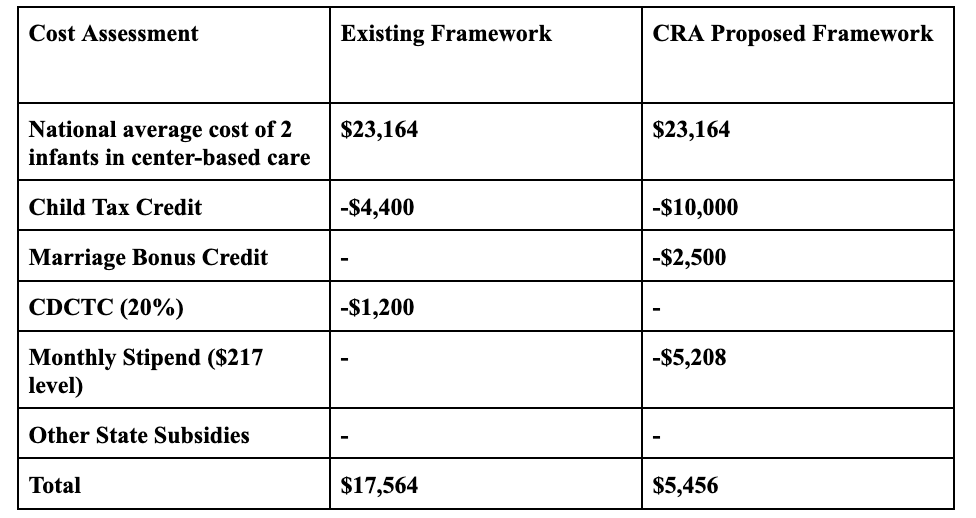
Combining these policy proposals for a typical married couple with two young children, both parents earning a combined median annual salary, and estimated yearly child-care costs of $23,164, could save $17,708 per year. The savings accrue from an enhanced per-child tax credit (CTC), a marriage bonus credit, and a middle-of-the-road child-care stipend of $217 per month per child aged 5 years and under. Meanwhile, under the existing framework, the same family would be able to claim only $4,400 for the CTC and, given their income, only 20% of the allowed Child and Dependent Care Tax Credit for two children, $6,000, leaving them with child care costs of $17,564 a year.
These are rough estimates, given the variable costs of care depending on the model used and the part of the country where the family lives; in most states, the couple’s income is too high to qualify for additional subsidies.
Conclusion
A pro–family formation policy agenda must be undergirded by the cultural affirmation of the value of parenting. For too long, a dominant narrative rooted in certain types of feminist ideology has implied that paid employment outside the home is inherently superior to caregiving at home. This narrative has harmed not only the well-being of families but also public respect for the work of raising children, which is infinitely valuable to the immortal souls of children and foundational to the social stability of the country.
Public policy should never reinforce the notion that child-rearing is a lesser choice. Instead, it should uphold and enable that choice where it is preferred while supporting those in non-ideal circumstances with dignity and flexibility.
The child-care affordability debate has too often been defined by technocratic fixes that assume parents lack preference or virtue in their caregiving choices. This paper argues for a reframing rooted in freedom, dignity, and family flourishing. By expanding the Child Tax Credit, incentivizing marriage, reforming subsidies into a flexible stipend, fostering informal care networks, and cutting counterproductive regulation, public policy can restore parental choice and family stability as central goals.
Endnotes
1. U.S. Census Bureau, “Income and Poverty in the United States: 2024,” September 2025, https://www.census.gov/data/tables/2025/demo/income-poverty/p60-286.html.
2. Allan C. Carlson, The American Way: Family and Community in the Shaping of the American Identity (ISI Books, 2003).
3. Theodore Roosevelt, Motherhood the Duty of Woman, The New York Times, March 14, 1905, https://www.nytimes.com/1905/03/14/archives/motherhood-the-duty-of-womanroosevelt-only-as-exceptions-are.html.
4. Theodore Roosevelt, “Eighth Annual Message,” Miller Center, University of Virginia, December 9, 1908, https://millercenter.org/the-presidency/presidential-speeches/december-9-1908-eighth-annual-message; Theodore Roosevelt, “Social and Industrial Justice,” Theodore Roosevelt Association, August 1912, https://theodoreroosevelt.org/content.aspx?page_id=22&club_id=991271&module_id=338367.
5. Theodore Roosevelt, Prefatory letter, October 18, 1902 (in B. Van Vorst and M. Van Vorst, The Woman Who Toils (Doubleday, Page & Co., 1903), https://www.gutenberg.org/files/15218/15218-h/15218-h.htm.
6. Allan C. Carlson, The American Way: Family and Community in the Shaping of the American Identity (ISI Books, 2003).
7. Theodore Roosevelt, “The Outlook,” Theodore Roosevelt Center, April 8, 1911, https://www.theodorerooseveltcenter.org/quotes/page/93/.
8. Margaret Harper McCarthy, “The Case for (Just) Sex Discrimination,” New Polity, December 17, 2024, https://newpolity.com/blog/sex-discrimination.
9. Ibid.
10. Robert VerBruggen, “High-Achieving Women and the Work-Family Balancing Act,” Institute for Family Studies (blog), December 16, 2025, https://ifstudies.org/blog/high-achieving-women-and-the-work-family-balancing-act.
11. Wendy Wang and Jenet Erickson, “More Married Mothers of Young Children Are Working Full-Time,” Institute for Family Studies, November 2025, https://ifstudies.org/report-brief/more-married-mothers-of-young-children-are-working-full-time.
12. Ibid.
13. Board of Governors of the Federal Reserve System, Economic Well-Being of U.S. Households in 2024: Report on the Survey of Household Economics and Decisionmaking, Publication No. 8960, Federal Reserve Board, https://www.federalreserve.gov/publications/2025-economic-well-being-of-us-households-in-2024.htm.
14. Wendy Wang and Jenet Erickson, “More Married Mothers of Young Children Are Working Full-Time,” Institute for Family Studies, November 2025, https://ifstudies.org/report-brief/more-married-mothers-of-young-children-are-working-full-time.
15. Ibid.
16. Ibid.
17. Ibid.
18. Ibid.
19. Ibid.
20. Ibid.
21. Paige Hauser, “Primer: Family Formation in America’s New Golden Age,” Center for Renewing America, April 11, 2025, https://americarenewing.com/issues/primer-family-formation-in-americas-new-golden-age/.
22. Internal Revenue Service, “Child Tax Credit,” U.S. Department of the Treasury, https://www.irs.gov/credits-deductions/individuals/child-tax-credit.
23. National Conference of State Legislatures, “Federal Funding Streams for Child Care and Early Childhood Education,” updated May 13, 2024, https://www.ncsl.org/state-federal/federal-funding-streams-for-child-care-and-early-childhood-education.
24. Office of Child Care, Administration for Children and Families, U.S. Department of Health and Human Services, “Child Care and Development Fund Final Rule: Frequently Asked Questions,” acf.gov, current as of June 4, 2025, https://acf.gov/occ/faq/child-care-and-development-fund-final-rule-frequently-asked-questions.
25. Office of Head Start, Administration for Children and Families, U.S. Department of Health and Human Services, “Head Start Program Facts: Fiscal Year 2024,” headstart.gov, accessed January 21, 2026, https://headstart.gov/program-data/article/head-start-program-facts-fiscal-year-2024.
26. Emily Wielk, “BPC’s Guide to the Child and Dependent Care Tax Credit,” Bipartisan Policy Center, March 12, 2025, https://bipartisanpolicy.org/explainer/guide-to-cdctc/.
27. Conor F. Boyle, Margot L. Crandall-Hollick, and Brendan McDermott, Child and Dependent Care Tax Benefits: How They Work and Who Receives Them, CRS Report R44993, Congressional Research Service, February 1, 2021, https://www.congress.gov/crs-product/R44993.
28. Certain programs for specialized populations could be retained, for example the Individuals with Disabilities Education Act and tribal child-care programs.
29. Federal Interagency Forum on Child and Family Statistics, America’s Children: Key National Indicators of Well-Bein, U.S. Government Printing Office, https://www.childstats.gov/americaschildren23/demo.asp.
30. This average conceals wide variation across age, location, and care setting, with annual costs ranging from more than $25,000 for center-based infant care in Washington, D.C., to less than $6,000 for home-based care for a four-year-old in some states. Sourced from Karen E. Lynch and Eva Su, Private Equity Investments in Large For‑Profit Child Care Organizations: In Brief, CRS Report R48252, Congressional Research Service, October 30, 2024, https://www.congress.gov/crs-product/,R48252.
31. Anna Claire Flowers, “New Tool Measures Child Care Regulation and Cost in the U.S.,” Institute for Family Studies (blog), November 6, 2024, https://ifstudies.org/blog/new-tool-measures-child-care-regulation-and-cost-in-the-us.
32. Ibid
Referenced Documents
Related Posts

Primer: Reducing Transportation Costs for American Families
The path to reliable and affordable transportation does not run through more federal spending, heavier top-down regulation, climate extremism, or capitulation to union bosses. It requires dismantling the administrative hurdles that inflate costs, restrict choice, and punish the working class.


Primer: Reducing the Costs of Real Food for Families
The animating concern of this series of primers is the future of healthy family formation. It is a central purpose of government to cultivate a country in which citizens can marry, have children, and remain married. The financial obstacles to that way of life are addressed throughout the series. Here we address rising food costs.